
Transcript
A. Introduction
In German criminal law, coercion (Nötigung) is an offence defined in s. 240(1) of the Criminal Code (StGB) as the unlawful compulsion of another person to a certain active or inactive behaviour, by force or threat of serious harm. S. 240 is thus a very broad and, accordingly, often disputed provision, constituting a sort of general clause for punishing the illegal exertion of pressure.
On the other hand, s. 253 contains the offence of extortion (Erpressung) as a crime against property in a wider sense, or wealth (Vermögen). S. 253(1) defines extortion essentially as coercion with the result of damaging another person’s assets.
S. 253 is sandwiched inbetween offences related to robbery (ss. 249-252) and extortion qualified by the use of force or threats of force (s. 255). The latter offence is in this sense doubly qualified; being a coercive act resulting in a loss of wealth as well as being committed in a robber-like fashion (räuberische Erpressung).
B. Elements of coercion
S. 240 demands that a certain means of coercion is employed and that this successfully leads to the victim behaving as it is meant to. Whereas the required success of s. 240 is therefore highly indefinite, the aforementioned means are in turn necessarily enumerated restrictively.
This is relatively straightforward as far as the latter variant is concerned, threats being defined as the explicit or implicit promise of an evil due to happen – owing to the offender’s influence – unless the victim behaves as it is told. However, what constitutes the former variant – violence or force – has historically been and continues to be much less averse to extensive interpretation.
While some parties are presently trying to equate psychological pressure and physical violence in public discourse, past prosecutors and judges have already attempted the same: In the 70s and 80s, mere mental pressure was indeed recognized as “force“ as long as it was caused by some physical activity. In 1995, the Federal Constitutional Court (BVerfG) condemned this practice as an unconstitutional encroachment on the plain wording of the Criminal Code. Ever since, “force“ is limited to compulsion that is both exerted and effective physically. Hence, the criminalization of sit-in protests had to take a more creative route.
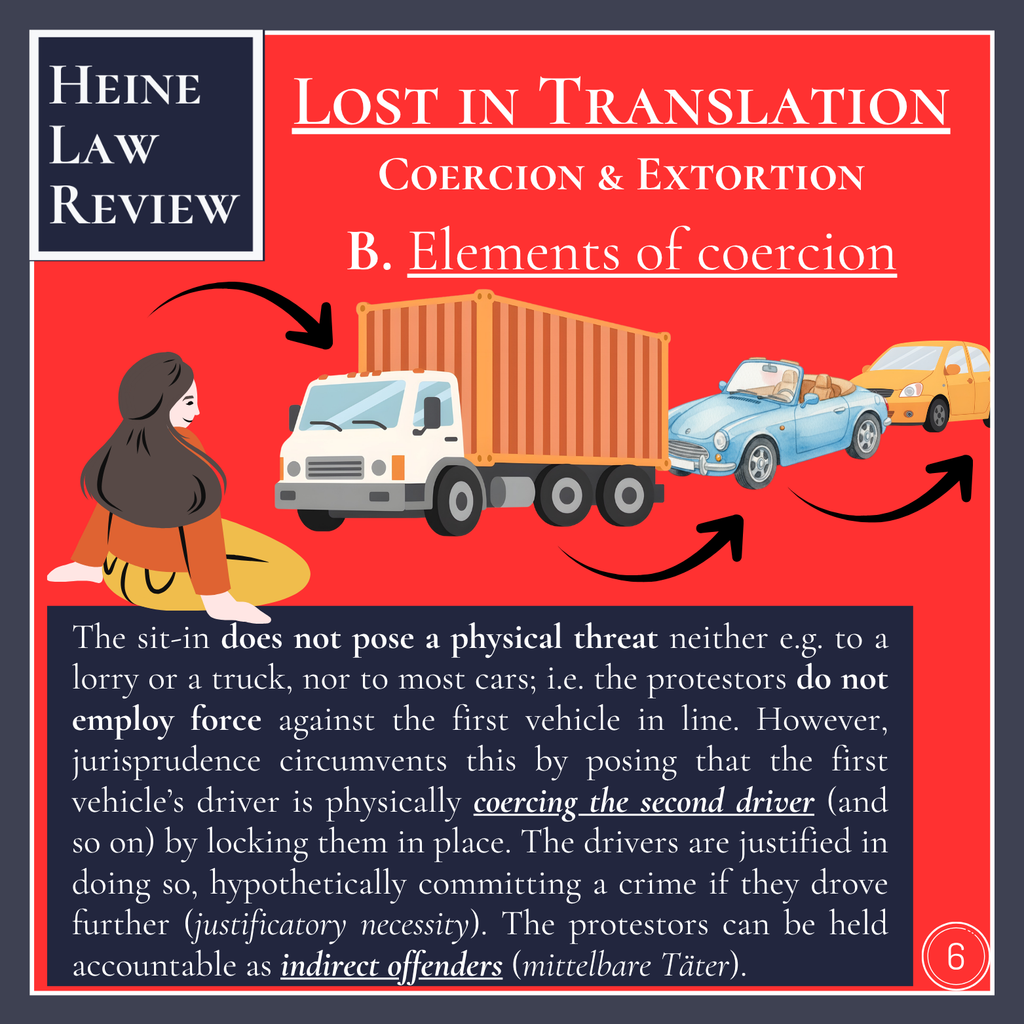
The sit-in does not pose a physical threat neither e.g. to a lorry or a truck, nor to most cars; i.e. the protestors do not employ force against the first vehicle in line. However, jurisprudence circumvents this by posing that the first vehicle’s driver is physically coercing the second driver (and so on) by locking them in place. The drivers are justified in doing so, hypothetically committing a crime if they drove further (justificatory necessity). The protestors can be held accountable as indirect offenders (mittelbare Täter).
C. Unlawfulness
As per s. 240(1), the coercion is not punishable if it is not unlawful. Unlike in other criminal provisions, this is not a mere reference to the general requirement of illegality. The unlawfulness of the act in question is not presumed in the absence of justificatory defences, but must be positively demonstrated.
S. 240(2) states that the act is unlawful if the use of force of the threat is deemed reprehensible in respect of the desired objective. S. 253(2) serves the same function for extortion. S. 255 lacks the requirement of unlawfulness altogether, as the qualified means of extortion are considered illegal per se.
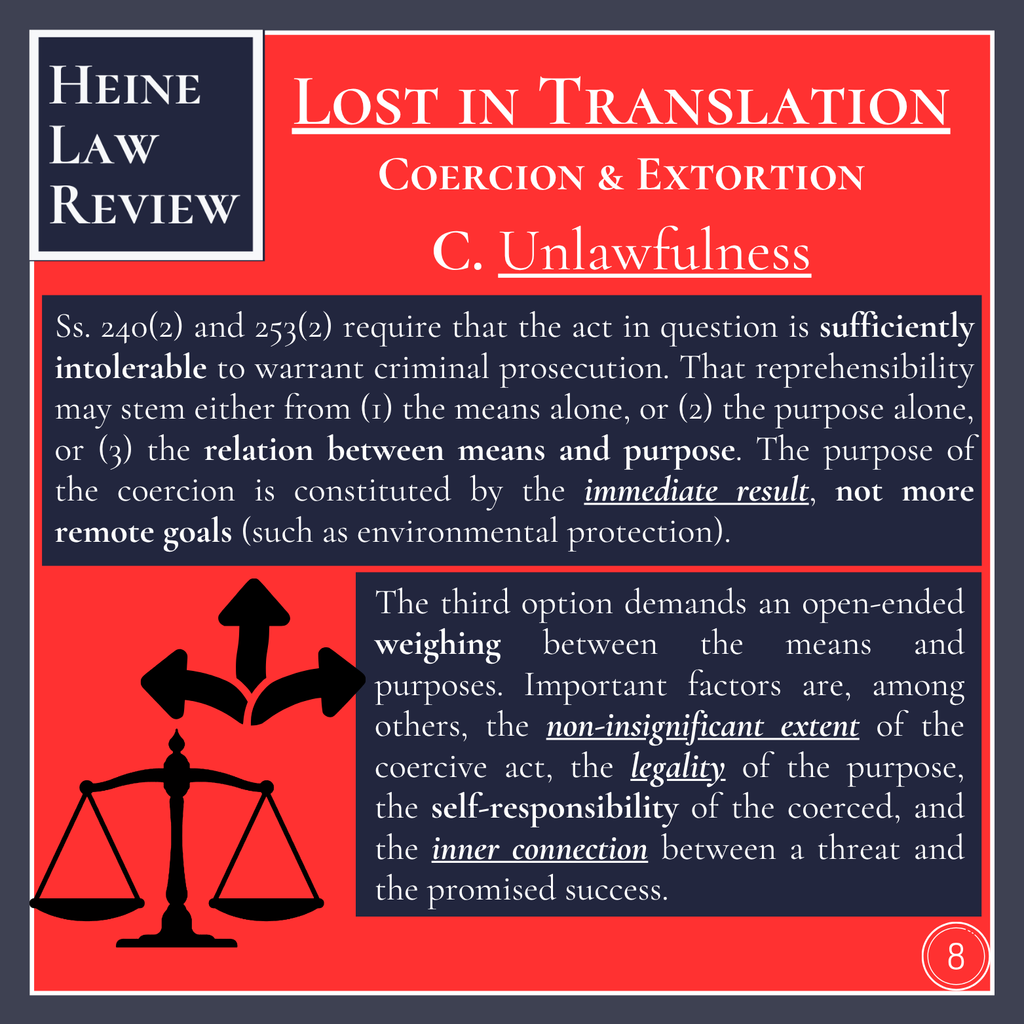
Ss. 240(2) and 253(2) require that the act in question is sufficiently intolerable to warrant criminal prosecution. That reprehensibility may stem either from (1) the means alone, or (2) the purpose alone, or (3) the relation between means and purpose. The purpose of the coercion is constituted by the immediate result, not more remote goals (such as environmental protection).The third option demands an open-ended weighing between the means and purposes. Important factors are, among others, the non-insignificant extent of the coercive act, the legality of the purpose, the self-responsibility of the coerced, and the inner connection between a threat and the promised success.