Continued from Lost in Translation: Coercion and Extortion (Part 1/2)
D. Elements of extortion
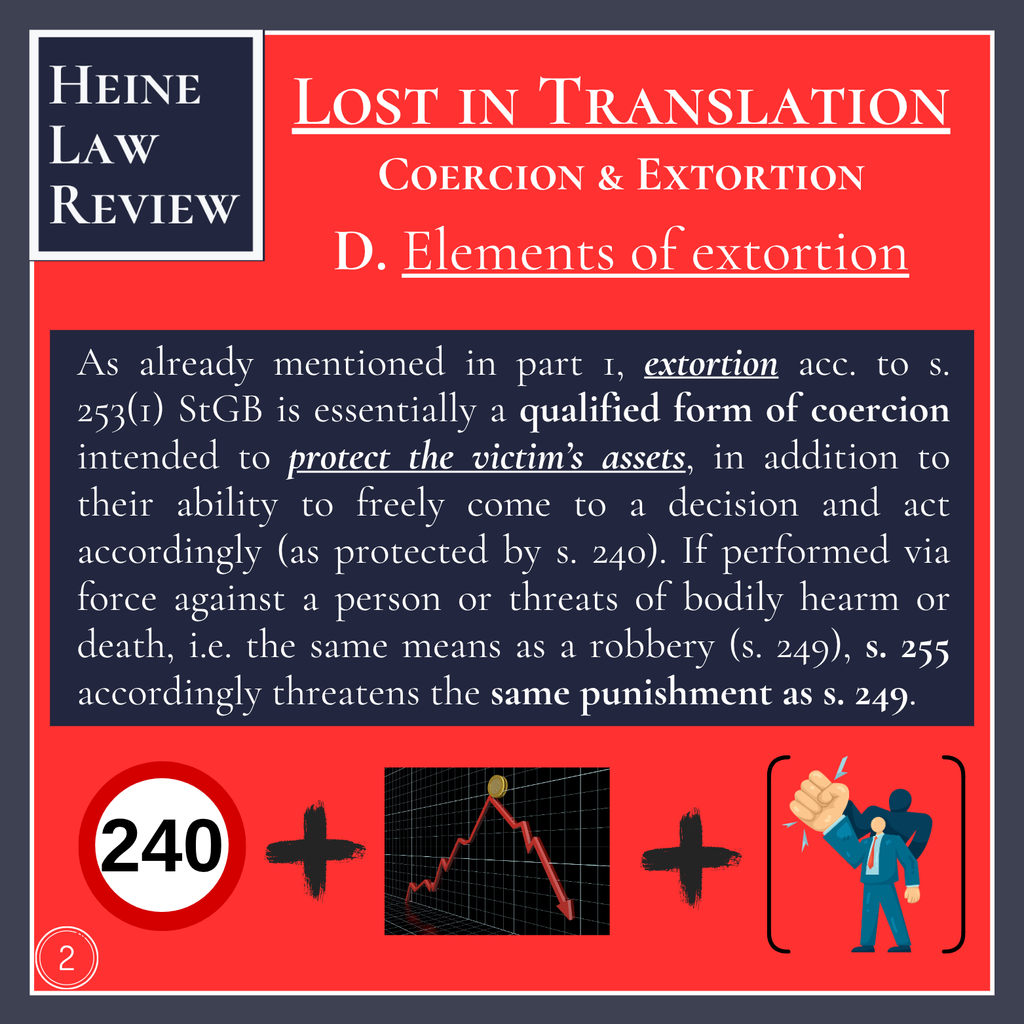
As already mentioned in part 1, extortion acc. to s. 253(1) StGB is essentially a qualified form of coercion intended to protect the victim’s assets, in addition to their ability to freely come to a decision and act accordingly (as protected by s. 240). If performed via force against a person or threats of bodily harm or death, i.e. the same means as a robbery (s. 249), s. 255 accordingly threatens the same punishment as s. 249.
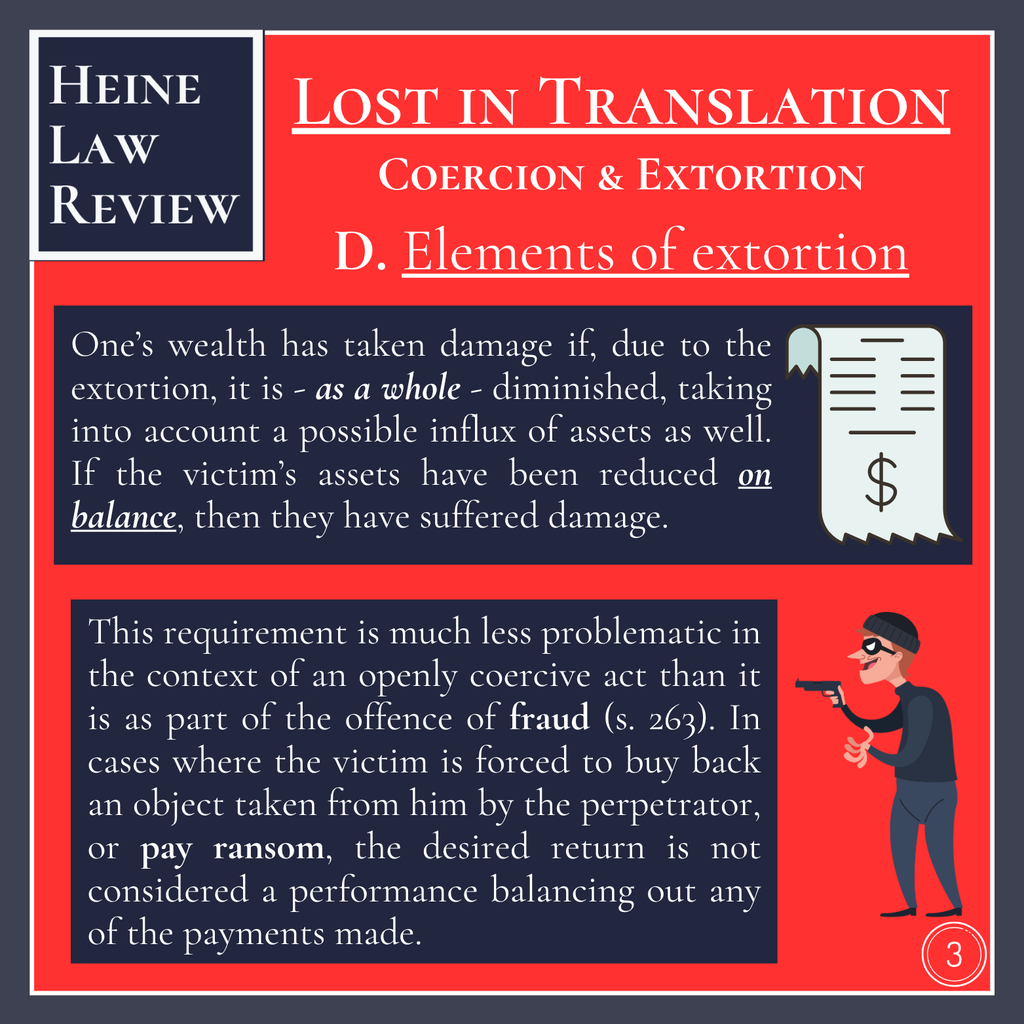
One’s wealth has taken damage if, due to the extortion, it is – as a whole – diminished, taking into account a possible influx of assets as well. If the victim’s assets have been reduced on balance, then they have suffered damage. This requirement is much less problematic in the context of an openly coercive act than it is as part of the offence of fraud (s. 263). In cases where the victim is forced to buy back an object taken from him by the perpetrator, or pay ransom, the desired return is not considered a performance balancing out any of the payments made.
The much more controversial aspect related to the elements of s. 253 (but mostly relevant in the context of s. 255) is that of a disposal over assets (Vermögensverfügung) as an intermediary success inbetween the coercive act and the damage (Vermögensschaden). The view taken by scholarship is that such a free and wilful disposal by the victim is necessary in order to distinguish between, as a matter of speaking, self-harming offences like fraud and extortion on one hand and offences such as theft and robbery on the other, particularly in cases where the possession of objects is at stake.
Meanwhile, the responsible courts are of the opinion that no restriction to the plain wording of s. 253 is necessary. Every coercive act, even one that does not leave any agency to the victim (absolute force or vis absoluta) could constitute extortion and thus be equivocated with a robbery under the conditions of s. 255. The judicial view is thus that any robbery also represents an extortion while most scholars define extortion and robbery as elementally exclusive offences. For the purposes of the verdict, the courts assume that any situation where it appears like an object is being handed over (not being taken) should be sentenced as a case of extortion.
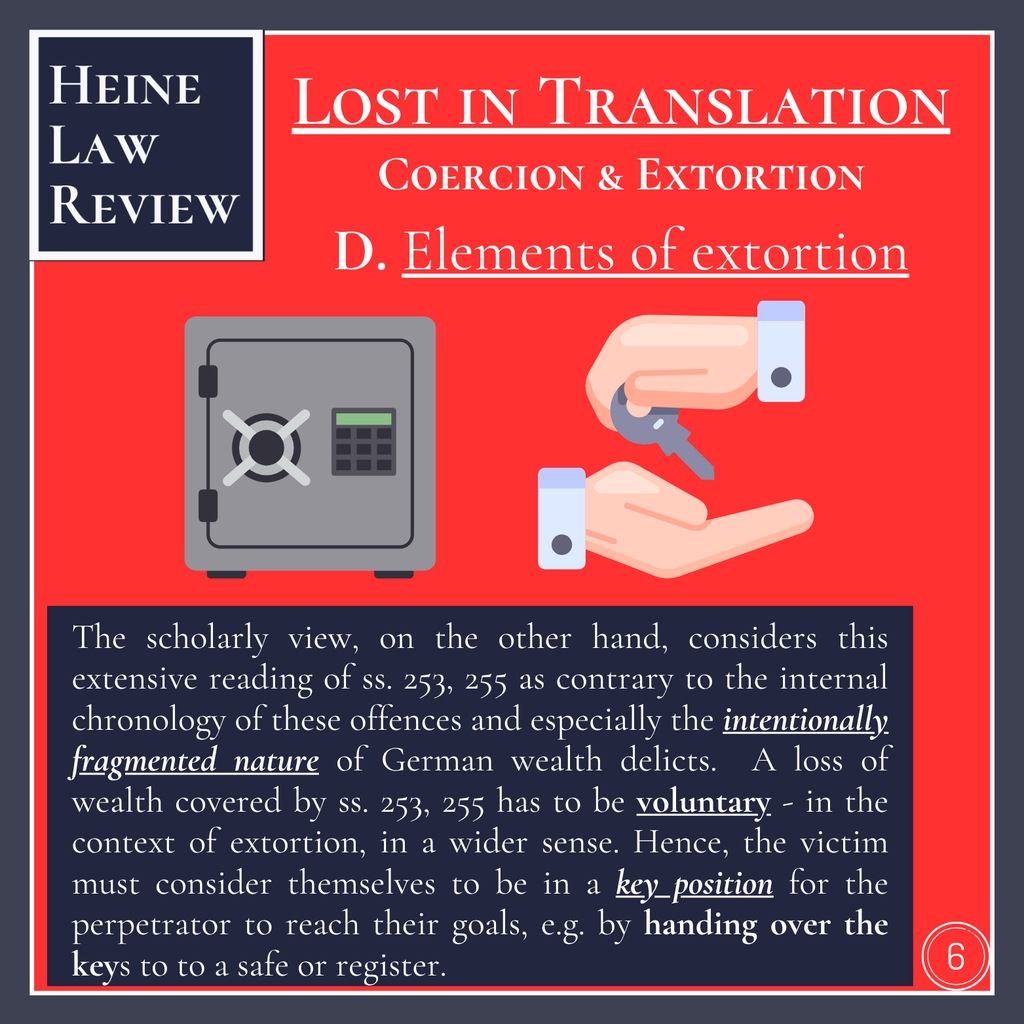
The scholarly view, on the other hand, considers this extensive reading of ss. 253, 255 as contrary to the internal chronology of these offences and especially the intentionally fragmented nature of German wealth delicts. A loss of wealth covered by ss. 253, 255 has to be voluntary – in the context of extortion, in a wider sense. Hence, the victim must consider themselves to be in a key position for the perpetrator to reach their goals, e.g. by handing over the keys to to a safe or register.
E. Extortion akin to robbery
S. 255 states that whoever commits extortion by using force against a person or threats of present danger to life or limb “incurs the same penalty“ as a robber. This reference does not exhaust itself in the sentencing of s. 249 (at keast one year) but also extends to the qualifications laid down in ss. 250, 251 – aggravated robbery and robbery resulting in death.
Another peculiarity of s. 255 is that – like with most other offences but unlike ss. 240 and 253 – the illegality of the deed is indicated by the elements being fulfilled and does not need to be positively demonstrated. These elements will be explained in a future instalment covering robbery.