





Transcript
A. Contract Formation
Both in German civil law and in English common law, the foremost condition for a contract is that two (or more) parties manifest their willingness to enter into one. These declarations are called offer (Angebot) and acceptance (Annahme).
Offer and acceptance require that, objectively, the parties presently intend to be bound on specific terms (Rechtsbindungswille). Therefore, the display of goods for sale, advertisements, or price lists, typically do not constitute binding offers. This does not apply, however, e.g. to the promise of a specific reward to anyone who takes the described action.
Any offer, in principle, may be revoked before it is accepted (Widerruf). A declaration of acceptance may generally not be revoked. However, statutes grant consumers the right to one-sidedly cancel “distance contracts“ and such.
The acceptance must be unconditional and final, corresponding to the exact terms of the offer (mirror image rule).
One important difference is certainly the posting rule. In Germany, an acceptance made via mail is generally effective once delivered. In England, the declaration of acceptance is effective when posted. This applies even if it is delayed or never delivered at all. It merely has to be correctly addressed, and it must initially be reasonable (not manifestly inconvenient or absurd) to use post.
B. Consideration
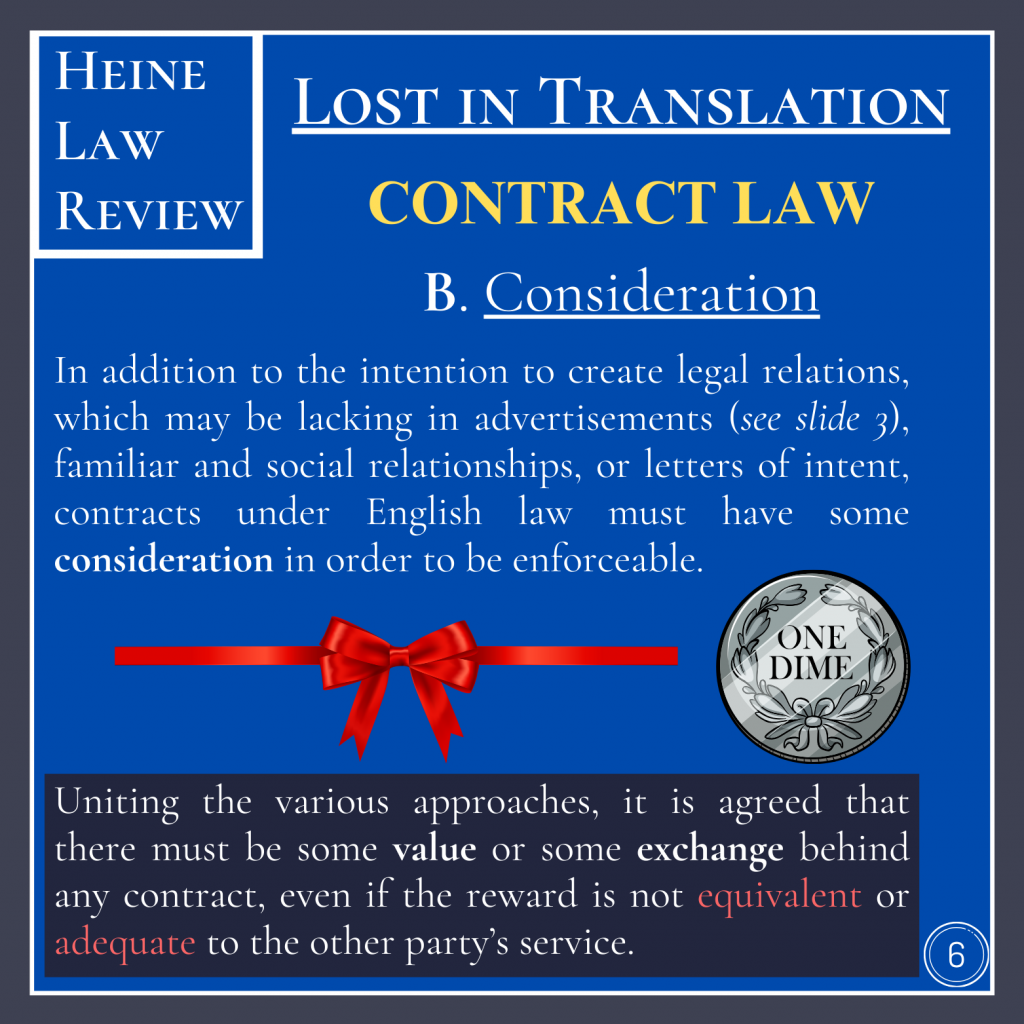
n addition to the intention to create legal relations, which may be lacking in advertisements, familiar and social relationships, or letters of intent, contracts under English law must have some consideration in order to be enforceable.
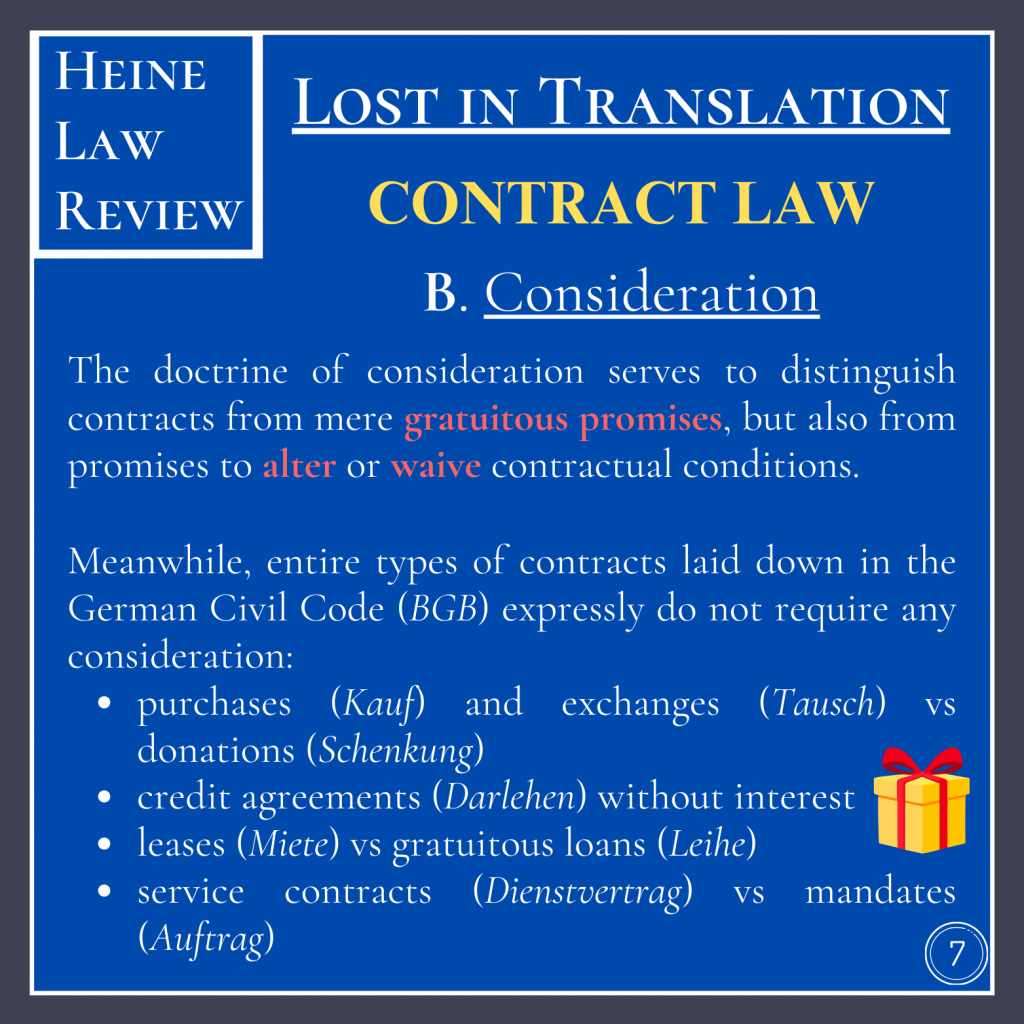
Uniting the various approaches, it is agreed that there must be some value or some exchange behind any contract, even if the reward is not equivalent or adequate to the other party’s service. The doctrine of consideration serves to distinguish contracts from mere gratuitous promises, but also from promises to alter or waive contractual conditions.
Meanwhile, entire types of contracts laid down in the German Civil Code (BGB) expressly do not require any consideration:
- purchases (Kauf) and exchanges (Tausch) vs donations (Schenkung)
- credit agreements (Darlehen) without interest
- leases (Miete) vs gratuitous loans (Leihe)
- service contracts (Dienstvertrag) vs mandates (Auftrag).
C. Good faith
Unlike German law (compare section 242 BGB) or the Uniform Commercial Code, common law does not recognize a general obligation to act in good faith (bona fide), i.e. to cooperate with the other party and, under certain circumstances, even neglect their own interests.
Instead, English courts opt for a piecemeal approach when deciding whether or not to enforce exemption clauses, penalties, unusual terms etc.
D. Estoppel
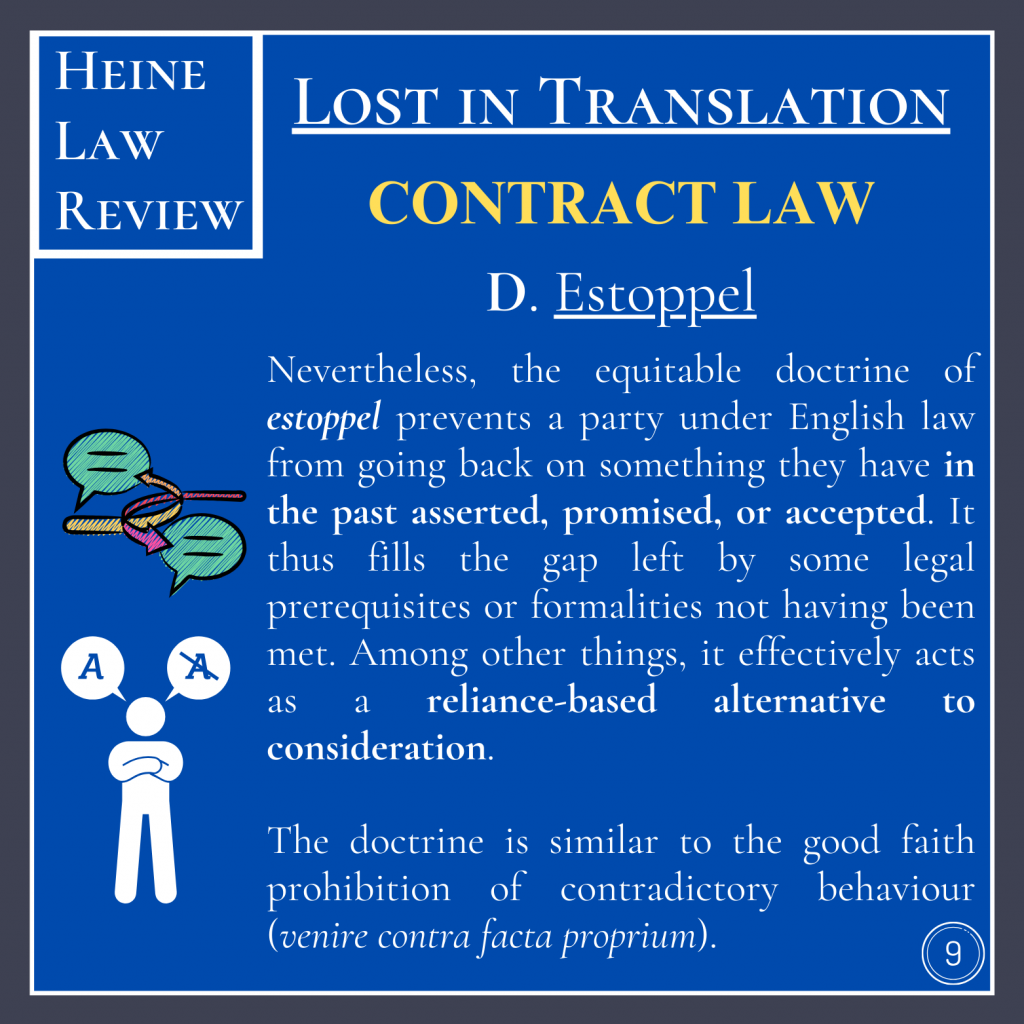
Nevertheless, the equitable doctrine of estoppel prevents a party under English law from going back on something they have in the past asserted, promised, or accepted. It thus fills the gap left by some legal prerequisites or formalities not having been met. Among other things, it effectively acts as a reliance-based alternative to consideration.
The doctrine is similar to the good faith prohibition of contradictory behaviour (venire contra facta proprium).