

Transcript
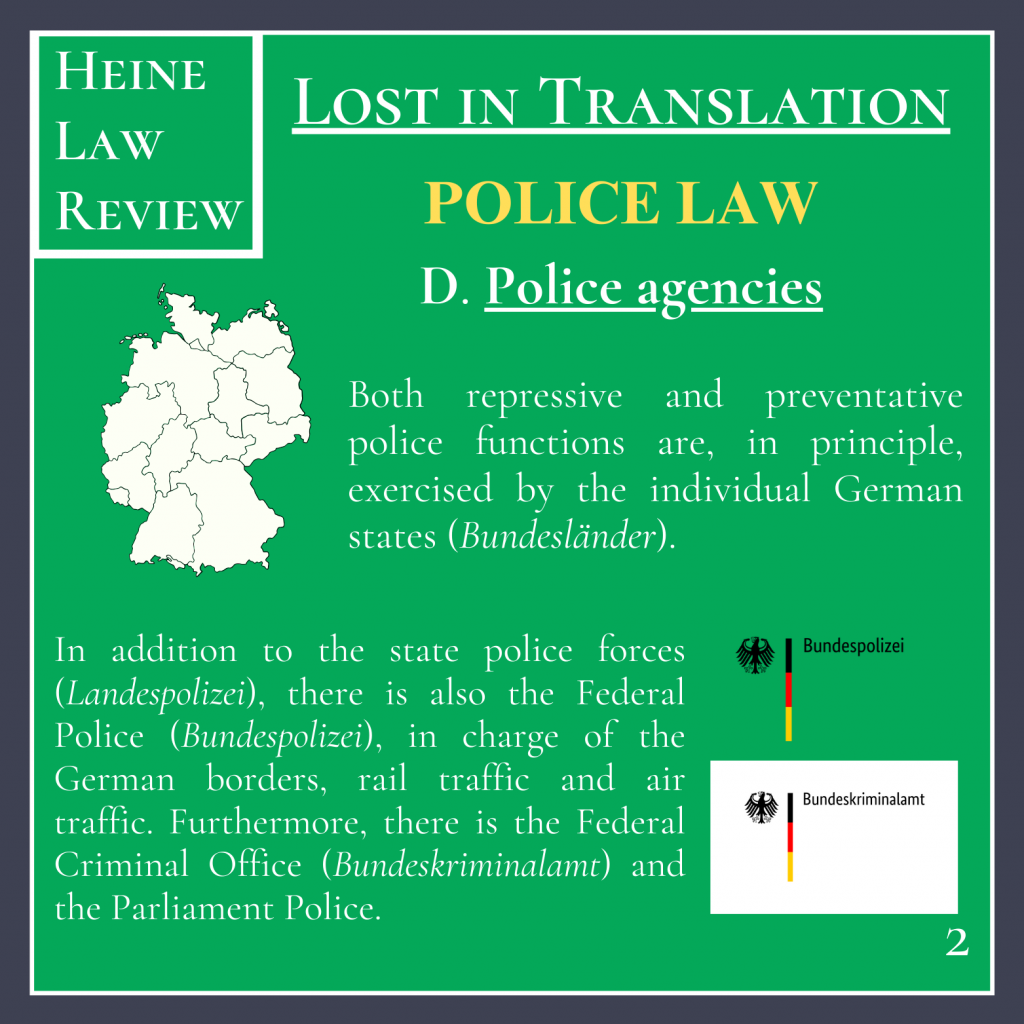
D. Police agencies
Both repressive and preventative police functions are, in principle, exercised by the individual German states (Bundesländer).
In addition to the state police forces (Landespolizei), there is also the Federal Police (Bundespolizei), in charge of the German borders, rail traffic and air traffic. Furthermore, there is the Federal Criminal Office (Bundeskriminalamt) and the Parliament Police.
E. Order enforcement agencies
After WW2, most of the newly established or reconstituted German states set out to somewhat disperse police power. As a consequence, the more mundane aspects of hazard control have since been outsourced to so-called order enforcement agencies (Ordnungsämter). These are controlled by the municipalities, not by the state.
Areas that are thus no longer considered police matters in the narrower sense include…
- supervising trades and industries
- taking care of public health, animal protection etc.
- overseeing private construction (e.g. issuing or denying building permits)
- prosecuting mere administrative offences
- running foreign nationals offices
- vehicle registration.
F. Public assemblies
One of the more sensitive aspects of police work is the supervision of public assemblies, as protected by Article 8 of the German constitution. An assembly in that sense is any gathering of a multitude of persons sharing common purposes, more specifically participating in the process of forming public opinion.
Whenever police action is directed towards such an assembly or its participants, the general rules are disapplied. Instead, police conduct is regulated by special assembly law.
In 2006, legislative power in this field was relinquished to the states. Many of them, such as Bavaria, Lower Saxony, Berlin or North Rhine-Westphalia, have since enacted their own laws. In all other states, the federal assembly statute is still applicable.
Essential contents of an assembly statute include…
- the duty of an organiser to notify the authorities beforehand (but not to apply for a permit), among other responsibilities
- the conditions under which an assembly may be banned or restricted, dispersed, or certain participants excluded
- bans on weaponry, masks, demonstrating in certain spaces etc.
- authorisation for other possible measures.
Police action under assembly law often requires not merely any danger for public security or public order but an immediate threat. The threat is immediate only if damage is highly probable to occur.
In recent times, there have been a number of controversial decisions on whether action may be taken on grounds of a high likelihood of illegal agitation (e.g. at pro-Palestine protests or party conferences).