Transcript
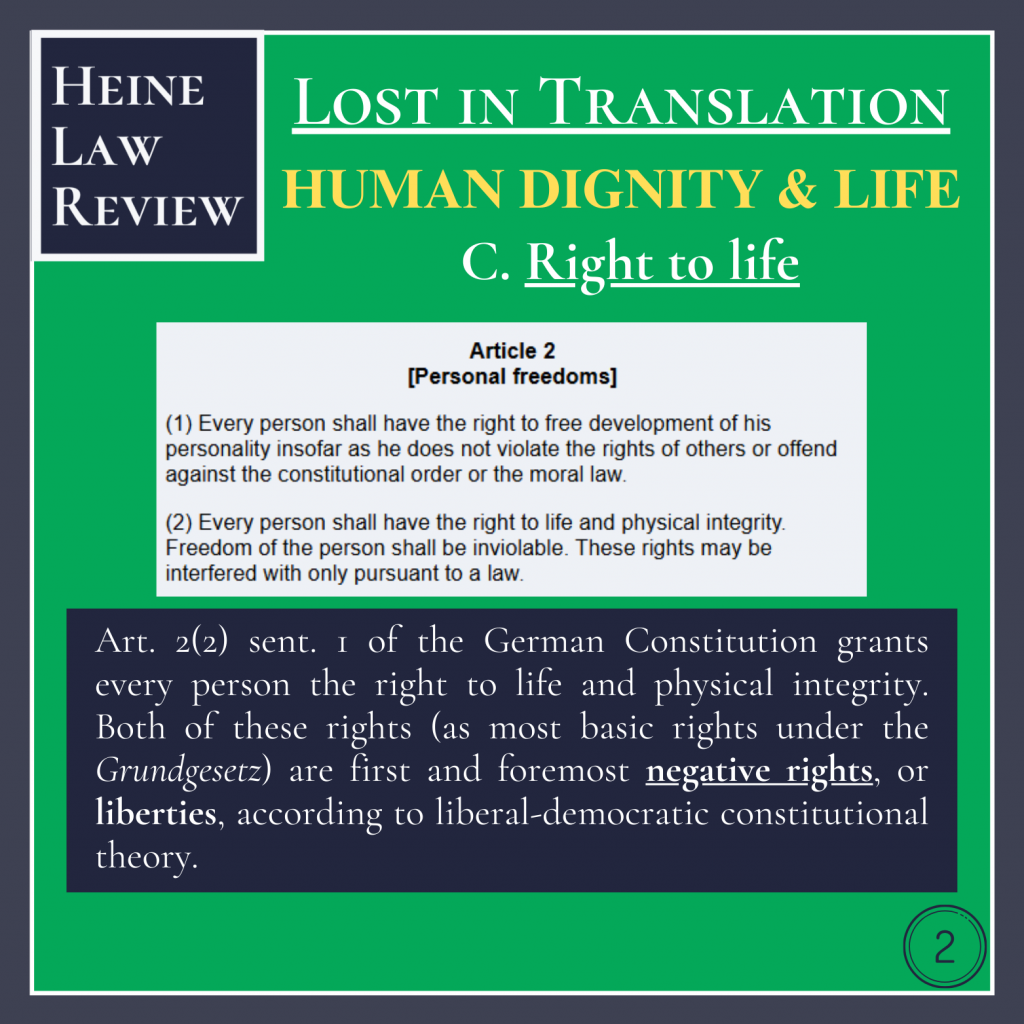
C. Right to life
Art. 2(2) sent. 1 of the German Constitution grants every person the right to life and physical integrity. Both of these rights (as most basic rights under the Grundgesetz) are first and foremost negative rights, or liberties, according to liberal-democratic constitutional theory.
This means that Art. 2(2) sent. 1 primarily serves to prohibit any unwanted interference with an individual’s bodily sphere. In addition to having to protect from violations by a third party, the state has to justify his own physical intrusions but also interventions against self-harming behaviour (e.g. an unhealthy lifestyle). The freedom to take one’s own life, however, is said to emanate from the general right of personality in Art. 2(1) and 1(1) instead.
Direct interference with an individual’s physical integrity can be justified e.g. with reference to emergencies or criminal investigations. Other limitations on bodily autonomy may require a state of irresponsibility such as adolescence or addictiveness. In contrast, which requirements apply to restrictions of the right to life, i.e. where killing is judged as permissible, depends on the exact relationship with the concept of human dignity…
D. Living in dignity
Human dignity and human life are clearly distinct concepts, as evidenced by the reservation for statutory regulation in Art. 2(2) sent. 3, as opposed to the absolute inviolability of human dignity acc. to Art. 1(1) sent. 1.
Human dignity is ultimately occupied with objectification. Since Art. 2 implies that killing may be justified in some circumstances, the decisive criterion for an impermissible degradation ultimately cannot be the deathly result itself.
In emergency situations, the rights to life and dignity demand not only that life ranks superior to other legal goods but also that (1) every human life is of the same quality, and (2) they are all infinitely valuable and therefore cannot be quantified. In other words, human lives may not be weighed against each other. While police or helpers may e.g. fire at a life-threatening hostage taker, they may not shoot down a hijacked plane in order to prevent weaponisation by terrorists.
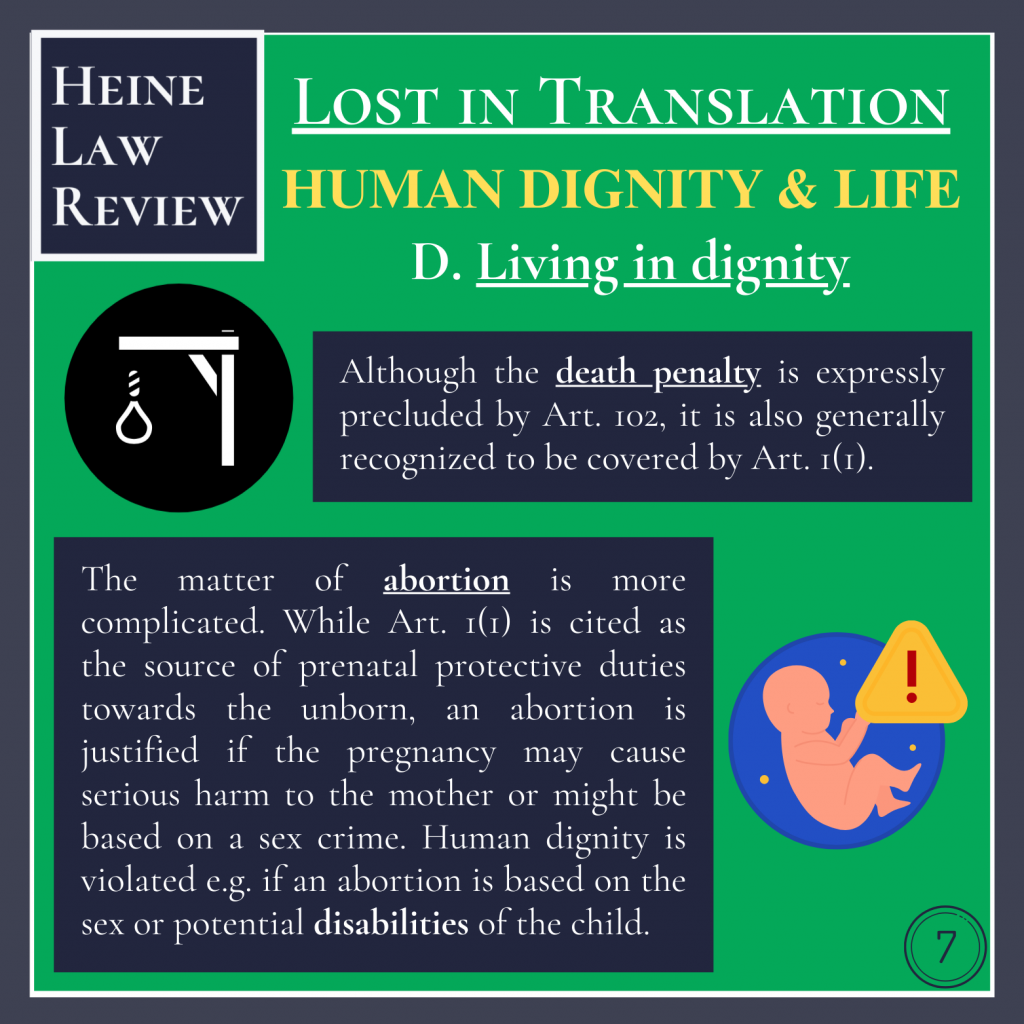
Although the death penalty is expressly precluded by Art. 102, it is also generally recognized to be covered by Art. 1(1). The matter of abortion is more complicated. While Art. 1(1) is cited as the source of prenatal protective duties towards the unborn, an abortion is justified if the pregnancy may cause serious harm to the mother or might be based on a sex crime. Human dignity is violated e.g. if an abortion is based on the sex or potential disabilities of the child.
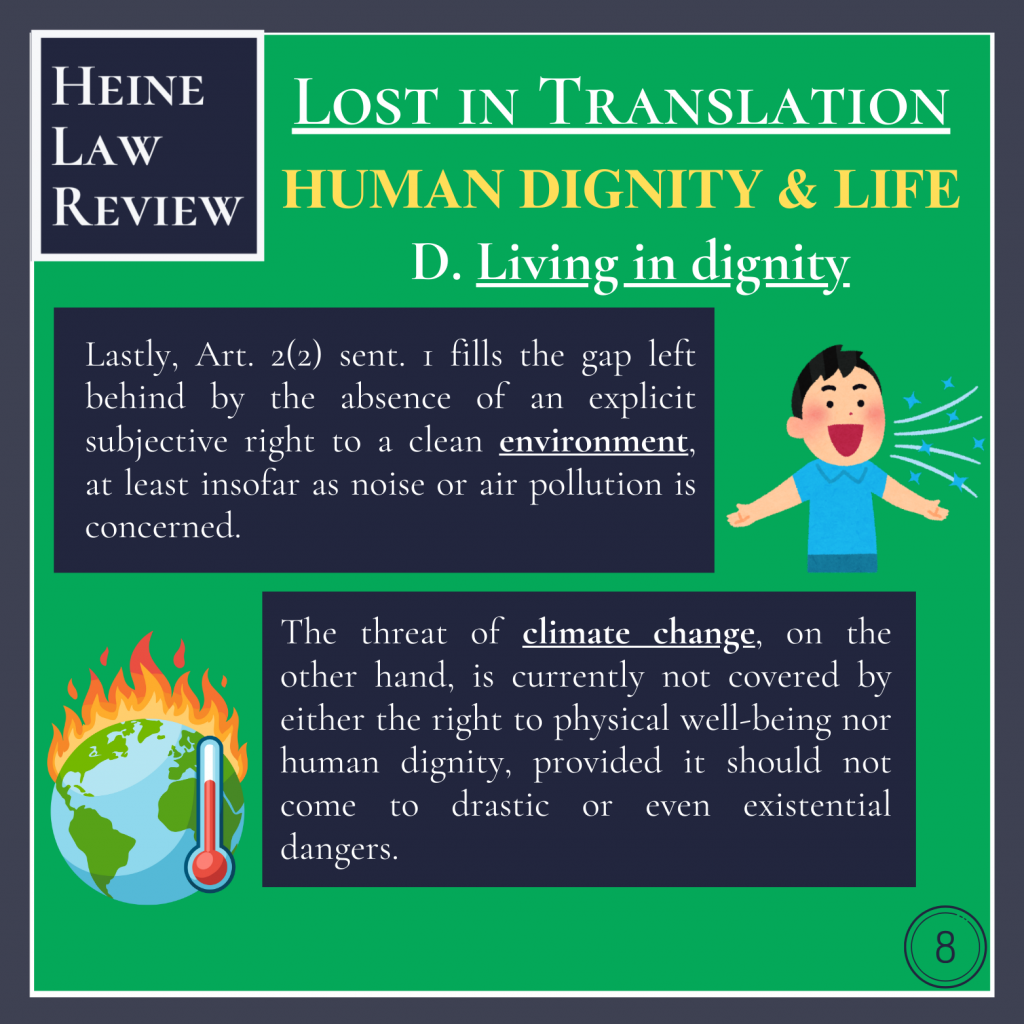
Lastly, Art. 2(2) sent. 1 fills the gap left behind by the absence of an explicit subjective right to a clean environment, at least insofar as noise or air pollution is concerned.
The threat of climate change, on the other hand, is currently not covered by either the right to physical well-being nor human dignity, provided it should not come to drastic or even existential dangers.