Transcript
C. Illegality and Guilt
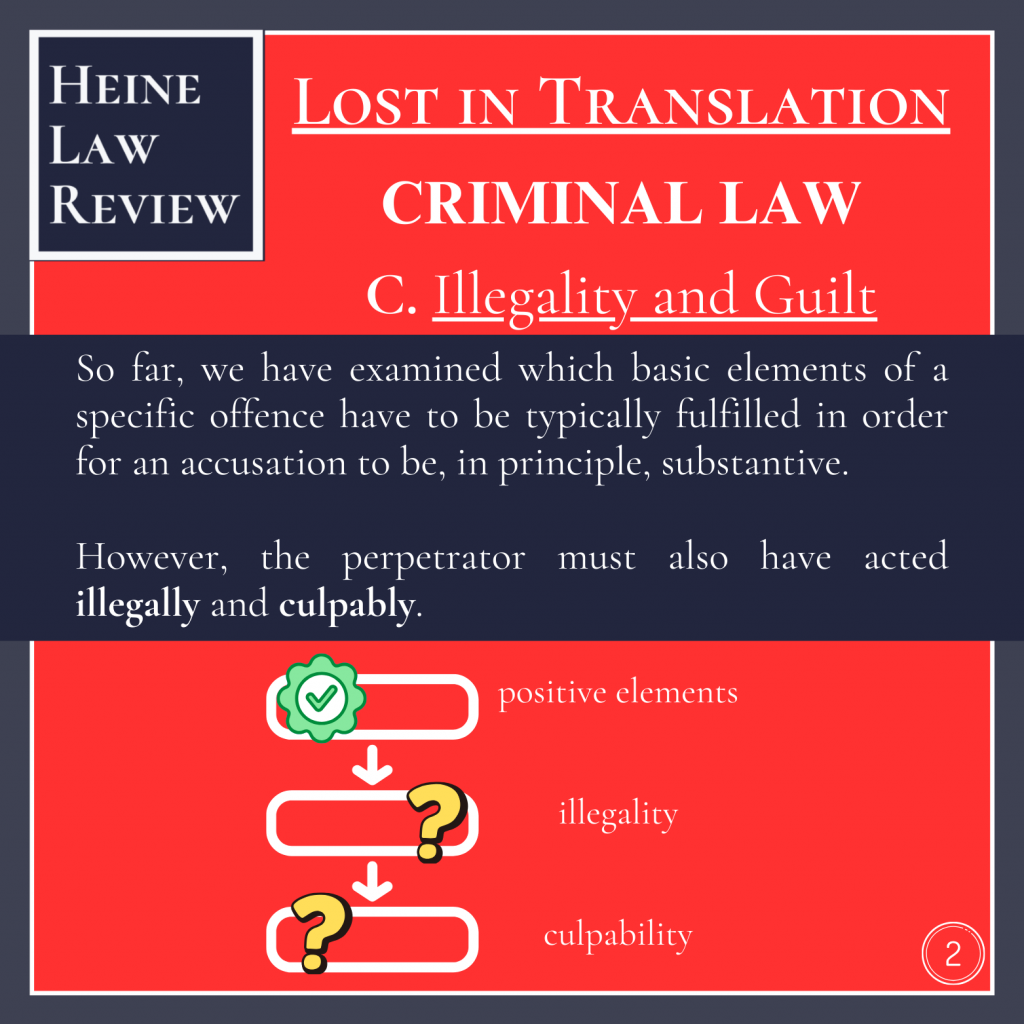
So far, we have examined which basic elements of a specific offence have to be typically fulfilled in order for an accusation to be, in principle, substantive. However, the perpetrator must also have acted illegally and culpably.
Most offences function in a way that, if their elements are present, this indicates the illegality of the perpetrator’s conduct. There are some exceptional offences where illegality as a condition of punishability must be positively demonstrated. Most importantly, this applies to coercion (Nötigung, s. 240) and extortion (Erpressung, s. 253).
The presumption of illegality may be countered by proving the applicability of one of the recognised justificatory defences, such as self-defence.
Similarly, the presumption of culpability may be disproven by invoking a lack of criminal responsibility or an excusatory defence.
D. Justification
There are several grounds of justification according to the Criminal Code (StGB):
- S. 32 allows for self-defence and the defence of a third party, meaning the violation of an illegal attacker’s rights as far as necessary.
- Per s. 34, a state of necessity justifies any violation that is proportionate to the potential harm being threatened.
- Finally, s. 193 stipulates a possibility for justification in cases of insulting someone while exercising legitimate interests.
Moreover, various other defences exist outside the bounds of the Criminal Code. Principal among these is the unwritten possibility to give consent to violations of one’s own rights. This is limited by s. 216 implying that consensual homicide is off-limits, and s. 228 making reservations for good morals in dealing bodily injuries.
Lastly, the Civil Code (BGB) contains some grounds, namely self-help (s. 229) and special property-related variations of necessity (ss. 228 and 904).
Someone imagining legal grounds for justification where there are none may be excused if the error was unavoidable (s. 17). On the other hand, the law does not explicitly state what happens if the perpetrator envisioned circumstances which would give rise to justification (Erlaubnistatbestandsirrtum). In the prevailing opinion, the offender in such cases acted illegally but without culpable intent. This approach has the advantage that the perpetrator is exempted from punishment (except for negligence) while someone leading him astray may be prosecuted for abetting an intentional and illegal offence.
E. Culpability
Criminal culpability positively requires that the offender does not lack criminal responsibility due to being under the age of 14 (s. 19). Above this threshold, someone lacks responsibility if they are incapable of appreciating the wrongfulness of their actions or of acting in accordance with any such appreciation due to a pathological mental disorder or similar condition (s. 20).
Excusatory defences, unlike justificatory defences fully legalising behaviour in which there is a predominant interest, relieve the perpetrator of responsibility in particularly stressful situations or personal conflicts. Among these are again states of necessity (s. 35) but also excesses in self-defence (s. 33).
Unavoidable mistakes of law serve the same function as excusatory defences or the rules on capability (see above).