Transcript
A. Human rights in Germany
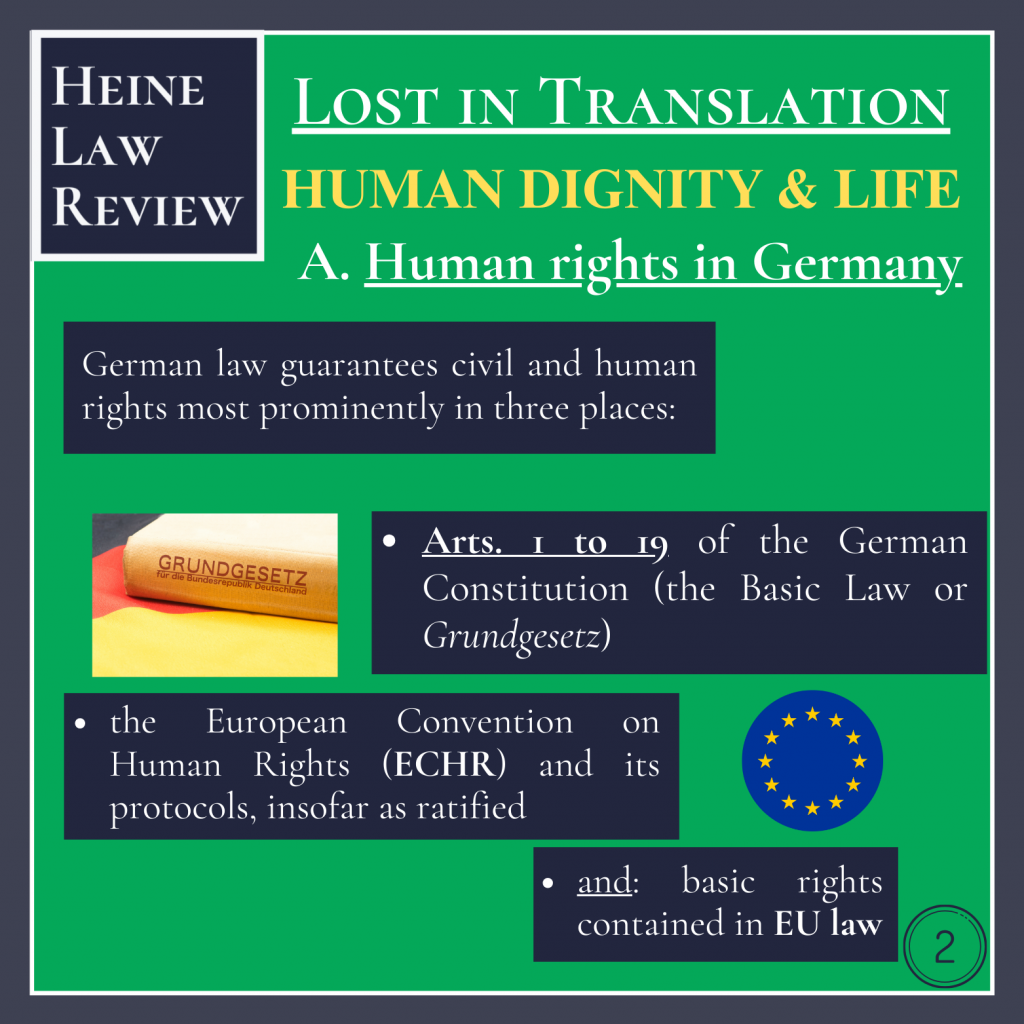
German law guarantees civil and human rights most prominently in three places:
- Arts. 1 to 19 of the German Constitution (the Basic Law or Grundgesetz)
- the European Convention on Human Rights (ECHR) and its protocols, insofar as ratified
- and: basic rights contained in EU law.
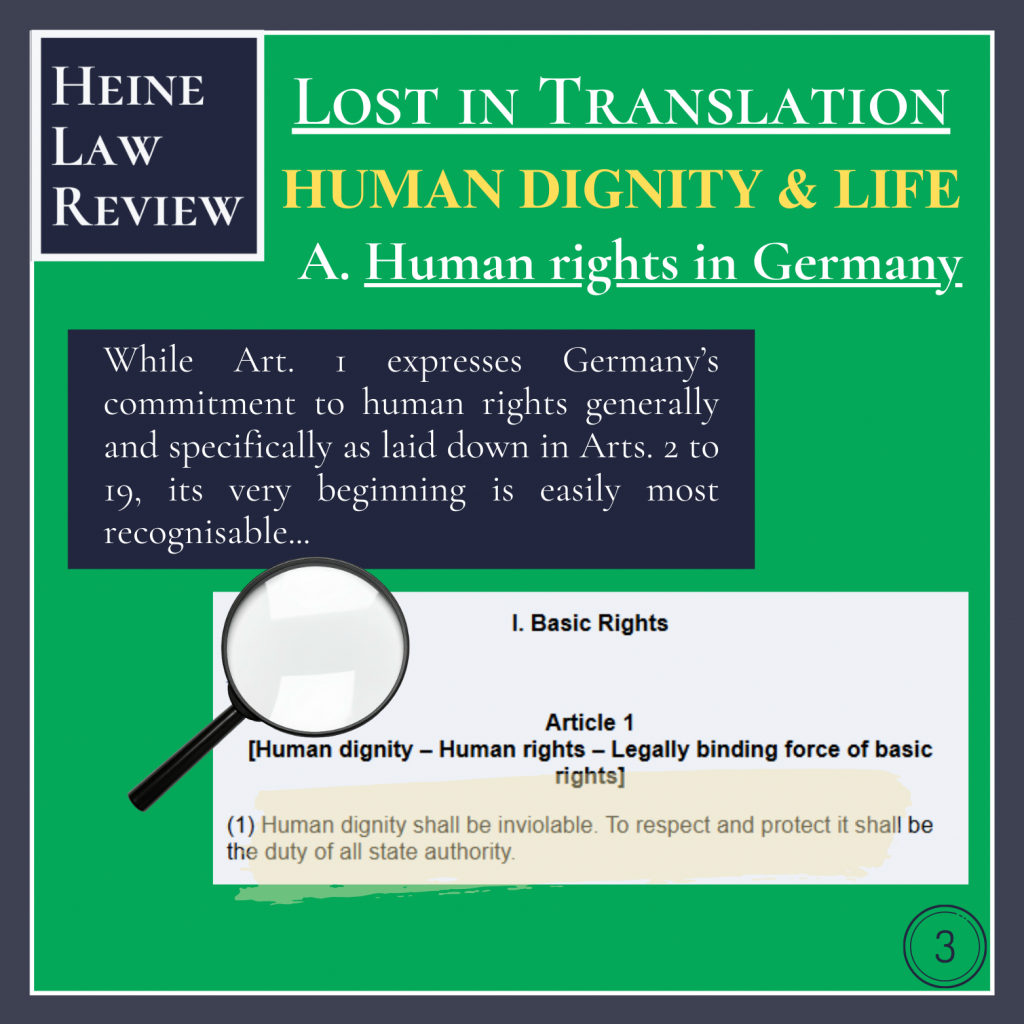
While Art. 1 expresses Germany’s commitment to human rights generally and specifically as laid down in Arts. 2 to 19, its very beginning is easily most recognisable…
Article 1 [Human dignity – Human rights – Legally binding force of basic-rights]
(1) Human dignity shall be inviolable. To respect and protect it shall be the duty of all state authority.
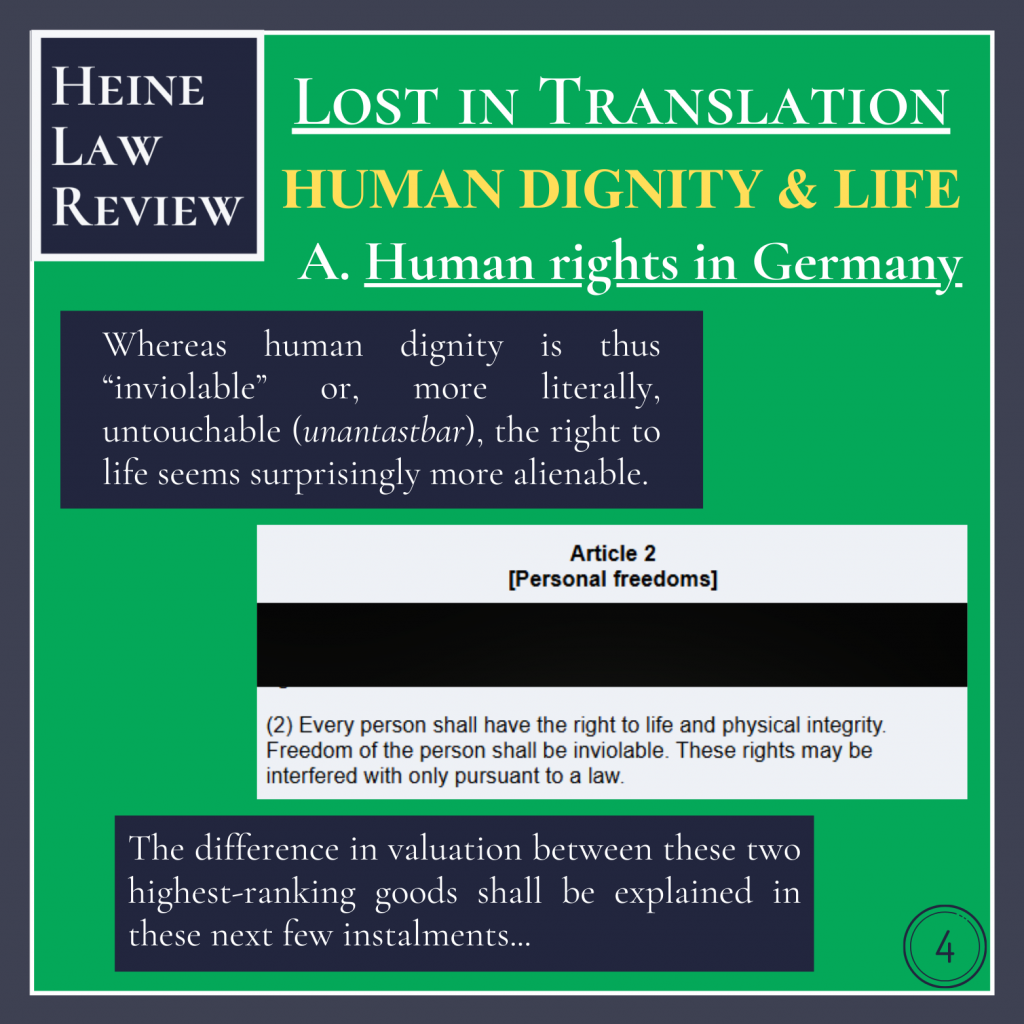
Whereas human dignity is thus “inviolable” or, more literally, untouchable (unantastbar), the right to life seems surprisingly more alienable.
Article 2 [Personal freedoms]
(2) Every person shall have the right to life and physical integrity. Freedom of the person shall be inviolable. These rights may be interfered with only pursuant to a law.
The difference in valuation between these two highest-ranking goods shall be explained in these next few instalments…
B. Defining dignity
Defining “human dignity” in the sense of Art. 1(1) has proven difficult. From the outset, it is disputed whether such dignity should be considered to stem from an external source (the Creator) as a gift given to every human being (Mitgifttheorie) or from one’s own capability to develop their personality (Leistungstheorie) or commune with society at large (Kommunikationstheorie).
The definition as delivered by the Federal Court of Justice (BGH) equates human dignity with every human’s claim to be respected and valued within society.
Jurisprudence has come to accept a restatement of Immanuel Kant’s idea of man as its own subject rather than merely the object of another agent’s actions. According to Günter Dürig (1958), human dignity is touched and thus violated if “an individual human is demoted to be an object, a mere means, an exchangeable unit.”
Of course, people very often use other human beings as means to their own ends. The boundaries of acceptability are breached, however, if someone is degraded to “a thing, which can be ‘comprehended’, ‘brought down’, ‘registered’, ‘liquidated’, ‘brainwashed’, ‘replaced’, ‘inserted’ or ‘abandoned’”, i.e. if someone’s value is denied in principle, be it by the state or by private citizens.
It has to be noted that the idea of what constitutes human dignity is deeply influenced by the factor that encroachments on it are unjustifiable. Since Art. 1 per Art. 79(3) even limits the powers of the legislature to alter the constitution with a two-thirds majority, it is held that Art. 1(1) in turn is restricted to guarantees that apply without any exception.
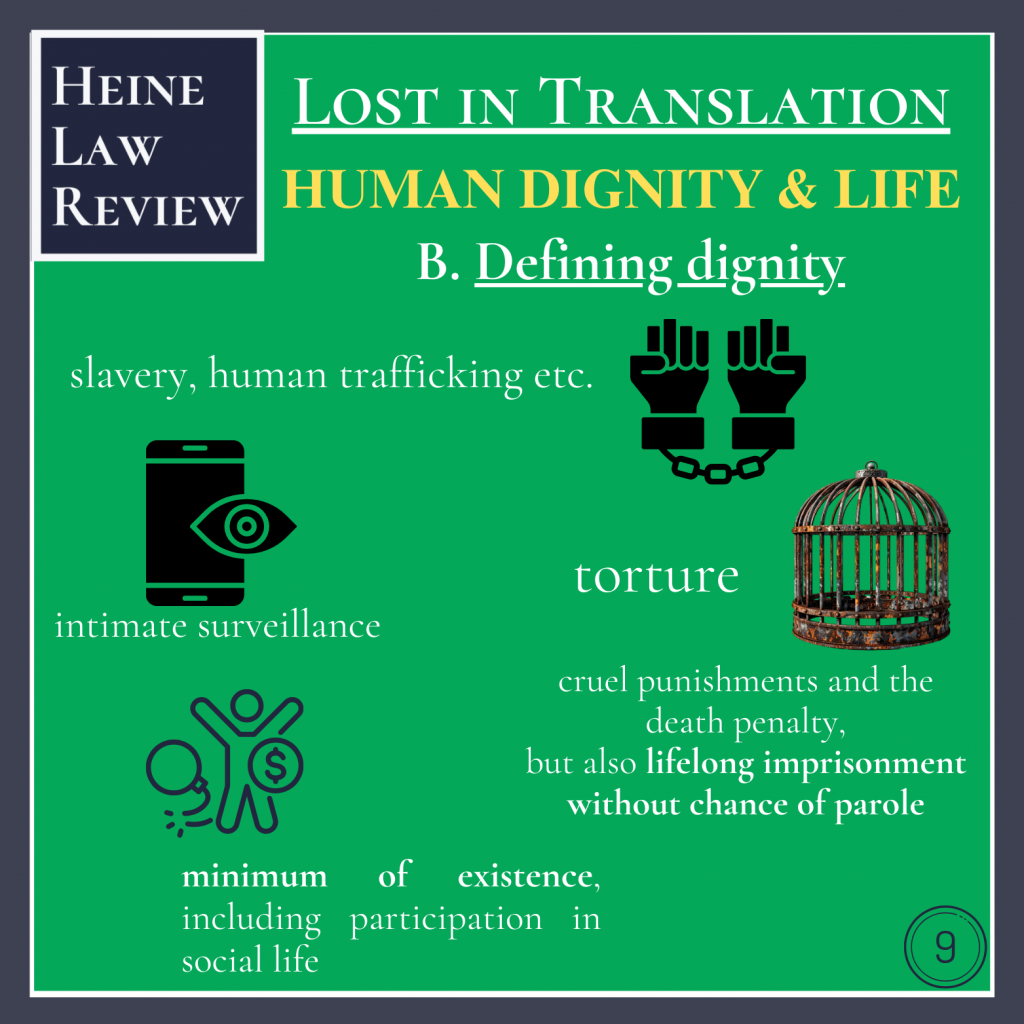
In practice, human dignity may therefore be understood better with reference to certain case groups…
- slavery, human trafficking etc.
- torture
- cruel punishments and the death penalty, but also lifelong imprisonment without chance of parole
- intimate surveillance
- minimum of existence, including participation in social life.