


Transcript
A. Introduction
After its enactment in 1949, Germany’s post-war constitution and its interpretation ultimately set a new standard for the protection of individual rights. This is true not just as concerns the quality of protection itself, but also due to the clarity of what was being granted, and the highly sophisticated dogma that would eventually develop.
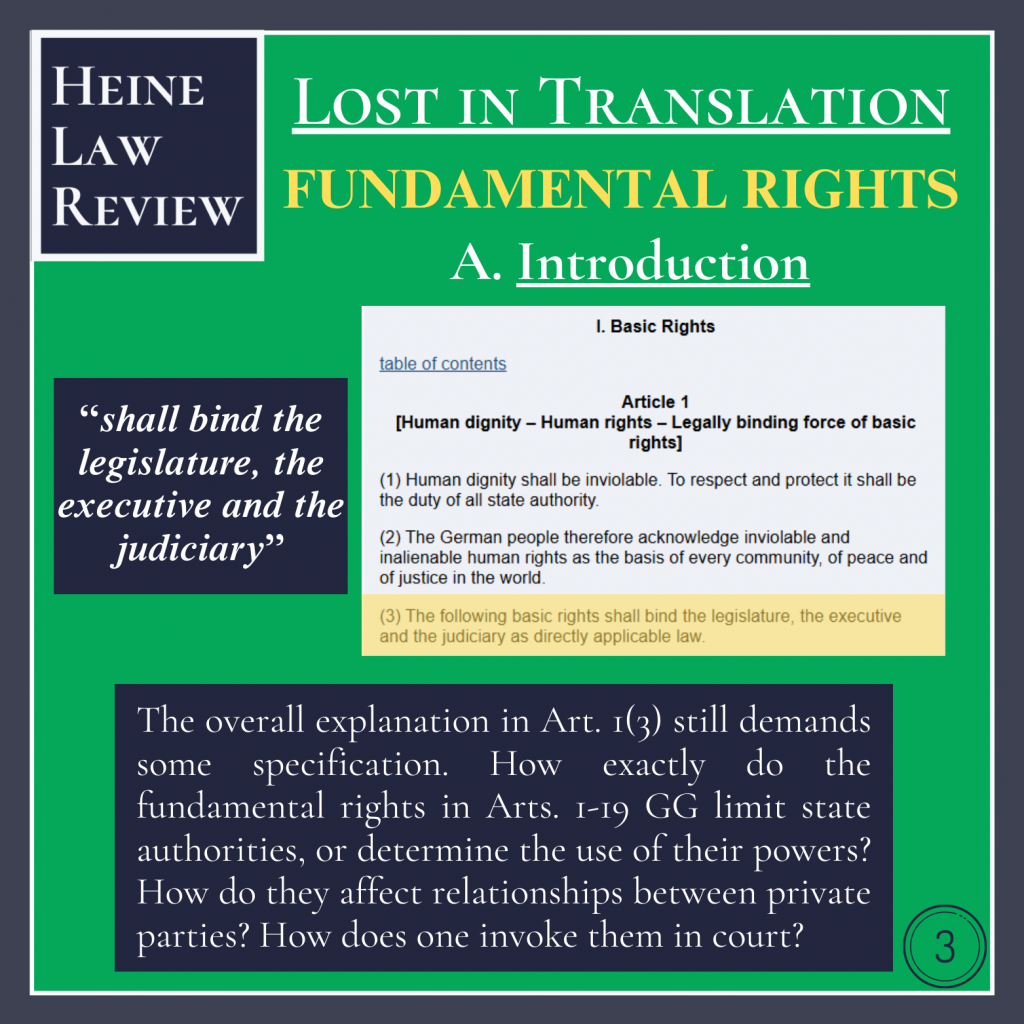
Art. 1(3): The following basic rights shall bind the legislature, the executive and the judiciary as directly applicable law.
The overall explanation in Art. 1(3) still demands some specification. How exactly do the fundamental rights in Arts. 1-19 GG limit state authorities, or determine the use of their powers? How do they affect relationships between private parties? How does one invoke them in court?
B. Negative rights
First and foremost, the rights enumerated in Arts. 1 ff. (except for the rights of equality in Art. 3) serve as negative rights, i.e. as protection against active state intervention in one’s conduct. Just see how Art. 2(2) s. 1 targets bodily threats or how Art. 2(2) s. 2 and Art. 104 restate habeas corpus while Art. 13 essentially contains the castle doctrine.
The negative dimension of freedom rights also refers to how the right not to do something is equally protected, e.g. to have a religious faith or to have none.
Now let’s look at how negative rights work in practice. Some rights guarantees provide that they may be interfered with (only) by or due to a law. However, this does not conversely mean that guarantees lacking such reservations may never or always be interfered with. Instead, any encroachment on fundamental rights requires a legal basis. Combine this with the fact that jurisprudence extends the general right of personality in Art. 2(1) to a general freedom of action, and you arrive at the principle that “everything which is not forbidden is allowed”!
When Art. 2(1) declares that one’s freedom reaches as far “as he does not violate the rights of others or offend against the constitutional order or the moral law”, the “constitutional order” refers not to the constitution itself but any law that conforms to it. Jurisprudence has also reduced the role of the “moral law“ and the “rights of others” if not regulated by law.
Acc. to Art. 1(3), basic and human rights bind not just the executive but also the legislature. Hence, interferences require both an enabling law and one that itself conforms to basic rights, or the constitution as a whole.
C. Positive rights
The opposite of negative rights are positive rights. The positive dimension of basic rights is double-barreled, as it encompasses both claims to certain goods or services, claims to participate e.g. in elections or petitions, and due process guarantees.
Claims to positive action by the authorities firstly include the state’s protective duties. As illustrated in previous editions, these are prominent e.g. in relation to human dignity, human life and bodily integrity.
The more contentious issue, however, is to what extent otherwise negative rights entitle to benefits, especially money payments. It is generally recognized that such entitlements cannot be derived from freedom rights in and of themselves. Still, these claims may be founded on so-called derivative participatory rights wherever benefits are granted to other persons. Dogmatically, these are based on the relevant freedom in conjunction with the right to equality before the law.