
C. Party Bans (continued)
Banning a German political party according to Art. 21(2), (4) GG requires that the party aims to impair or eliminate the free and democratic constitutional order or endanger the existence of the Federal Republic of Germany.

So far, there have only been two succesful bans: That of the Socialist Reich Party (SRP) in 1952, and that of the Communist Party of Germany (KPD) in 1956. Two other extreme right-wing associations, the Free German Worker’s Party (FAP) and the National List (NL) were banned by ministers of the interior, which was possible due to lack of party status.
Attempts to ban the National Democratic Party of Germany (NPD) were made twice, failing once due to procedural errors and once because of a lack of potentiality (see below).
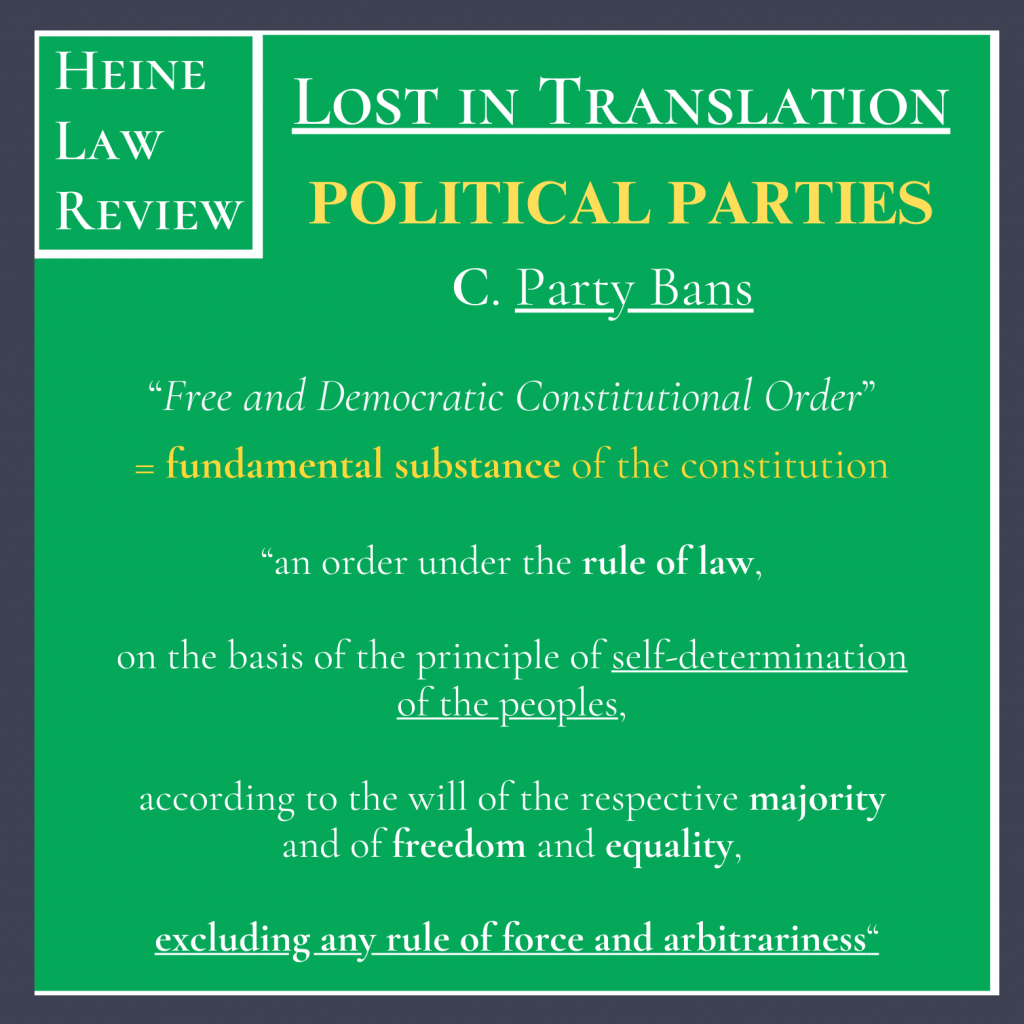
The term “free and democratic constitutional order” is restricted to the fundamental substance of the German constitution. Conventionally, it is defined as “an order under the rule of law, on the basis of the principle of self-determination of the peoples, according to the will of the respective majority and of freedom and equality, excluding any rule of force and arbitrariness“.
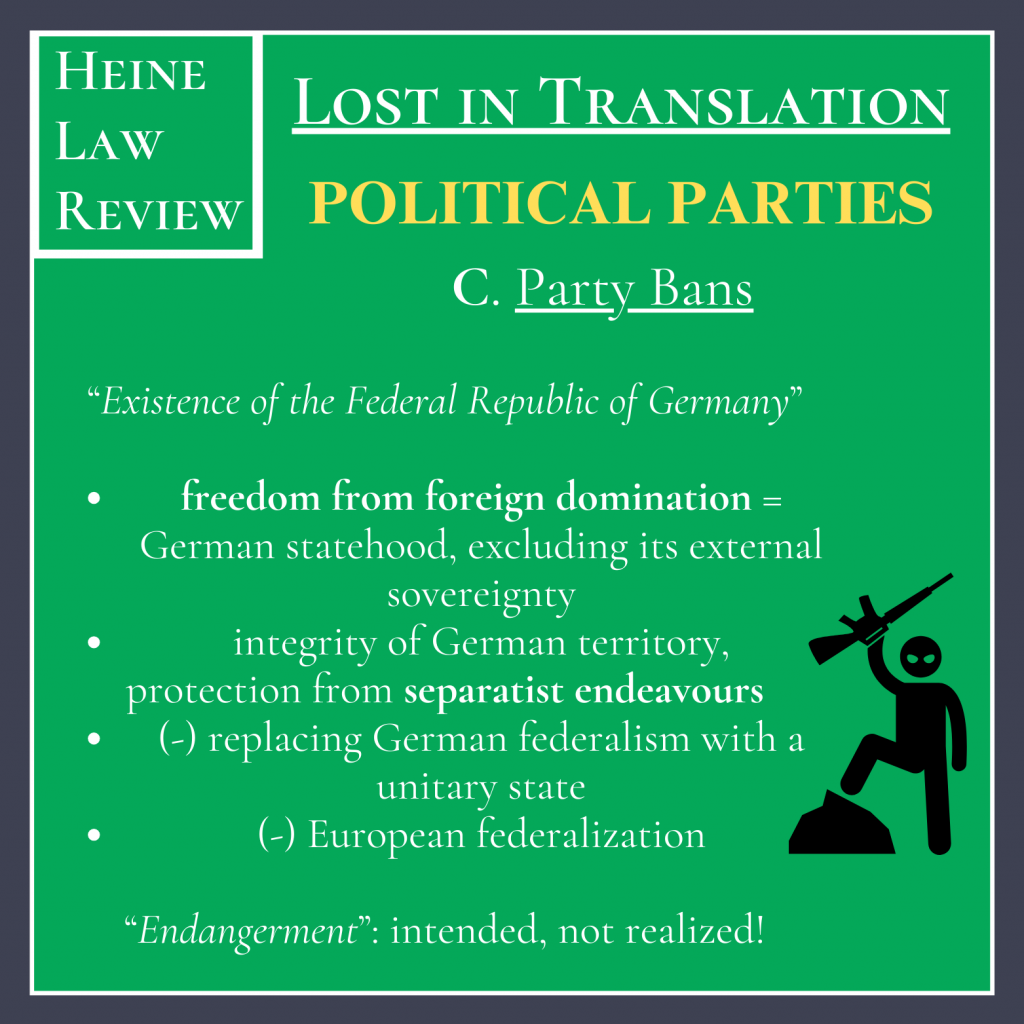
The existence of the Federal Republic of Germany includes both its freedom from foreign domination (German statehood) and its territorial integrity, also covering protection from separatist endeavours, but does not extend to Germany’s external sovereignty insofar as European federalization is concerned. Seeking to replace German federalism with a unitary state is also not illicit.
Germany’s existence is endangered as soon as actions such as described are intend, not just if they are realised.
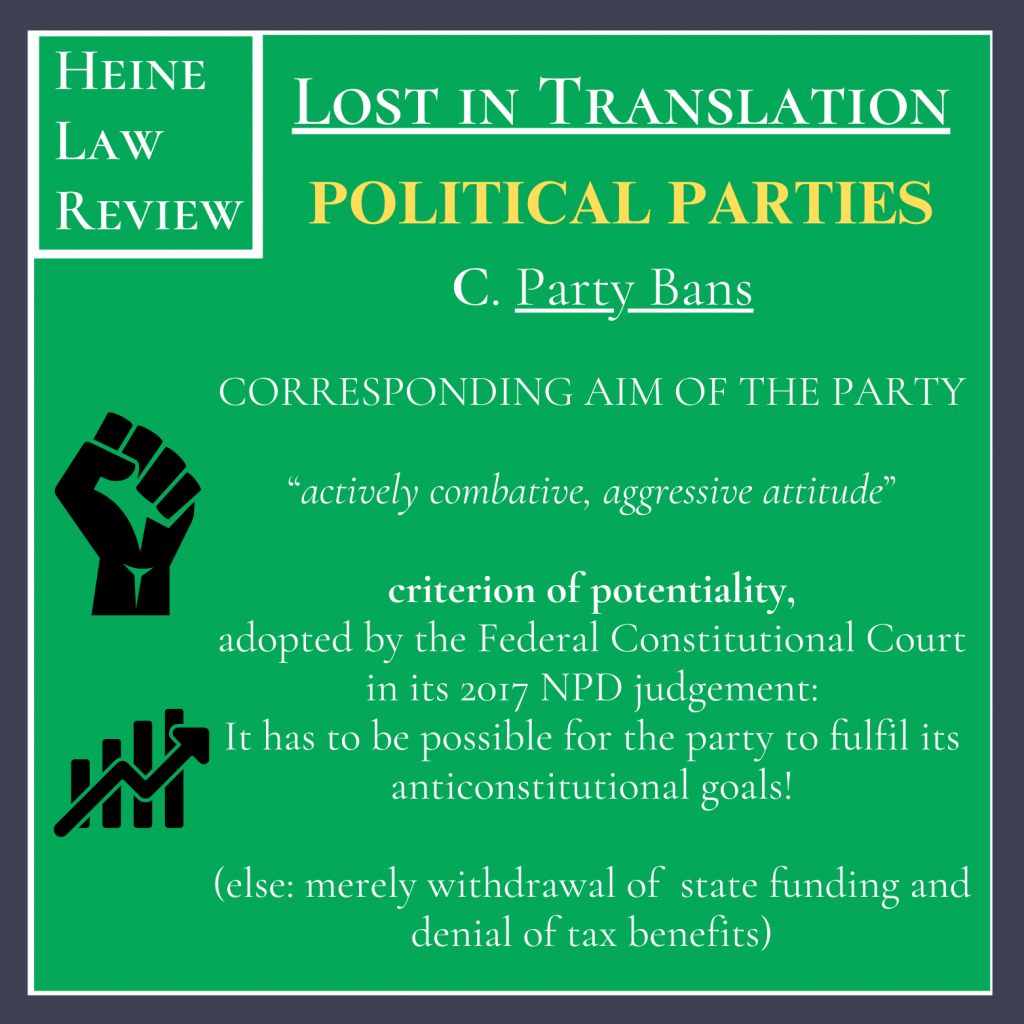
Endangering the constitutional order or the existence of the Federal Republic must be the aim of the party. The party must pursue it with an “actively combative, aggressive attitude“. Furthermore, the Federal Constitutional Court has adopted the criterion of potentiality in its 2017 NPD decision, meaning that it has to be actually realistic for the party to fulfil its anticonstitutional goals! Otherwise, the party may not be banned but merely excluded from state funding and tax benefits, per Art. 21(3).