

Transcript
A. Introduction
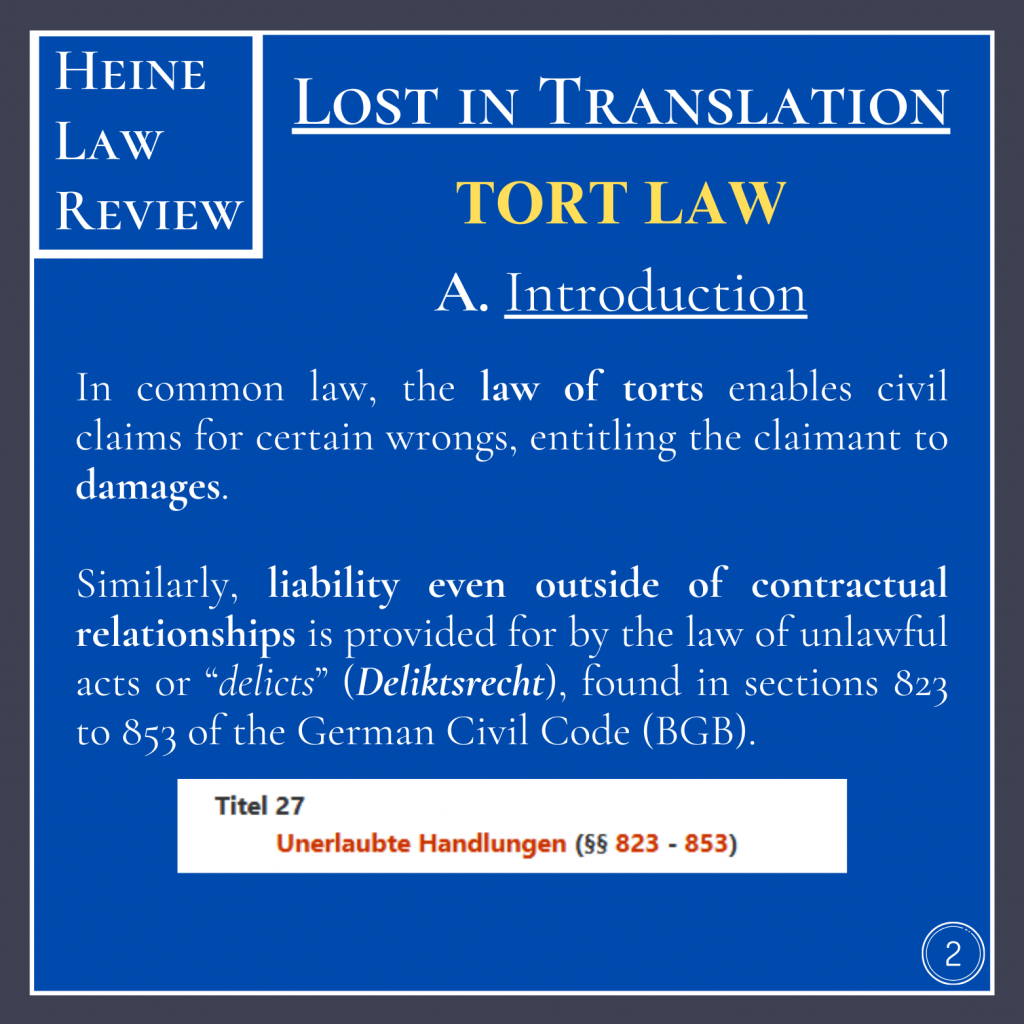
In common law, the law of torts enables civil claims for certain wrongs, entitling the claimant to damages.
Similarly, liability even outside of contractual relationships is provided for by the law of unlawful acts or “delicts” (Deliktsrecht), found in sections 823 to 853 of the German Civil Code (BGB).
B. System
The torts of English law are miscellaneous legal actions established by individual precedents. They may be subdivided into, for example, intentional torts (assault, battery, wrongful imprisonment etc.), the tort of negligence, or strict liability (e.g. nuisance).
Conversely, German tort law centres around several general and special clauses…
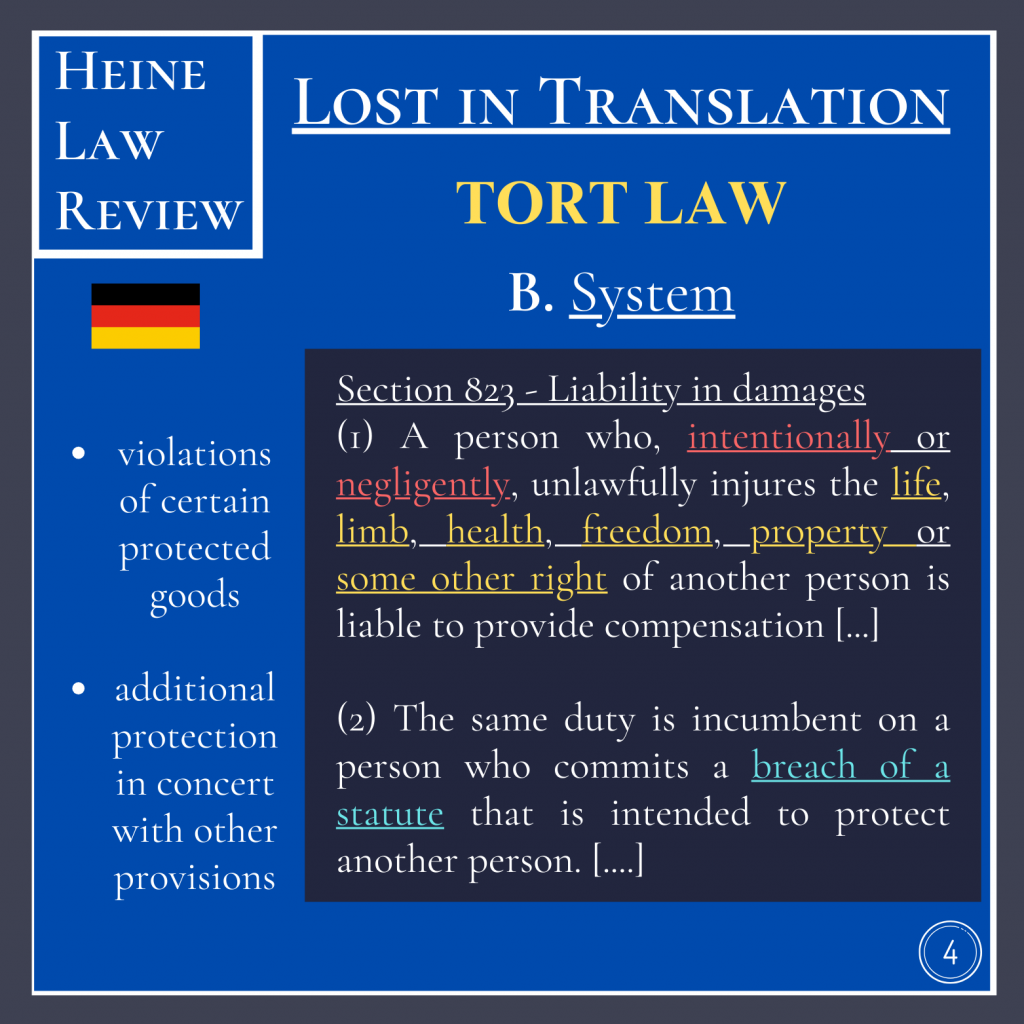
Section 823 – Liability in damages
(1) A person who, intentionally or negligently, unlawfully injures the life, limb, health, freedom, property or some other right of another person is liable to provide compensation […] = violations of certain protected goods
(2) The same duty is incumbent on a person who commits a breach of a statute that is intended to protect another person. [….] = additional protection in concert with other provisions
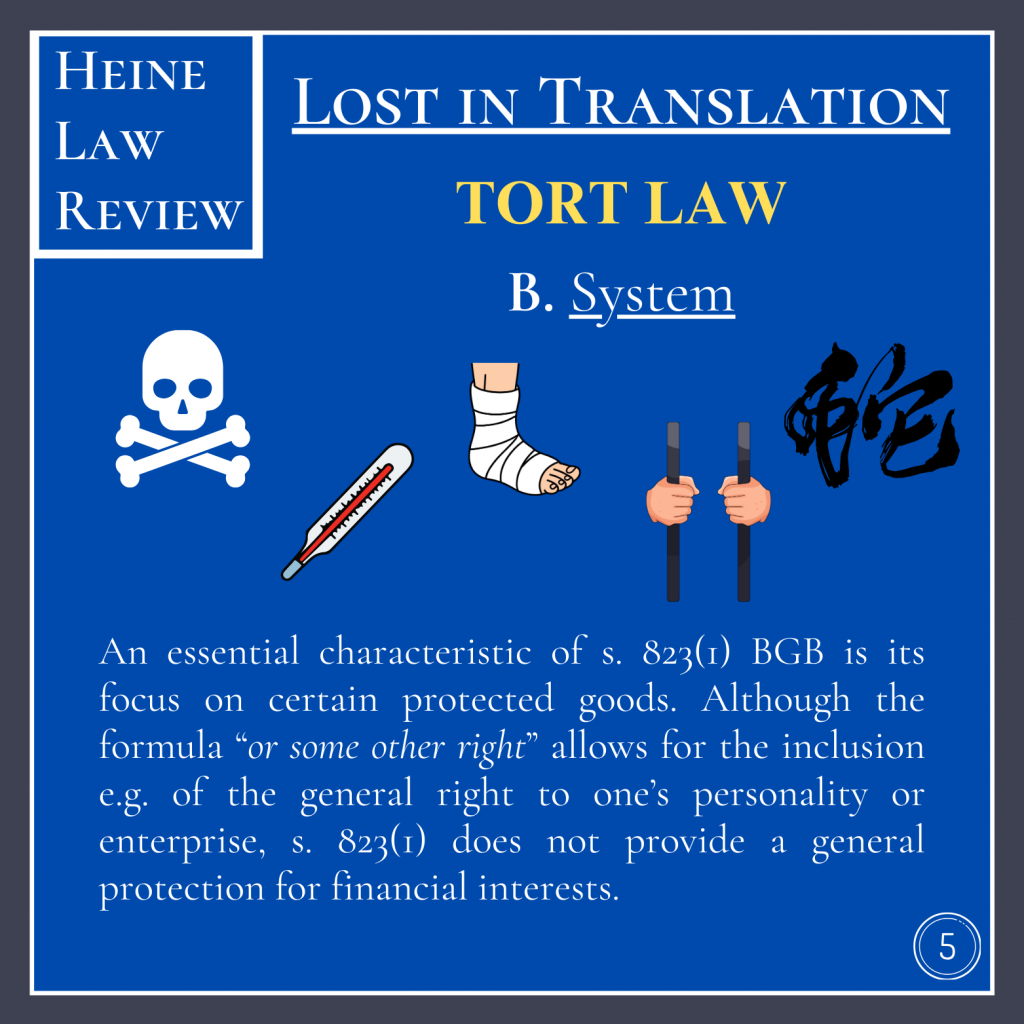
An essential characteristic of s. 823(1) BGB is its focus on certain protected goods. Although the formula “or some other right” allows for the inclusion e.g. of the general right to one’s personality or enterprise, s. 823(1) does not provide a general protection for financial interests.
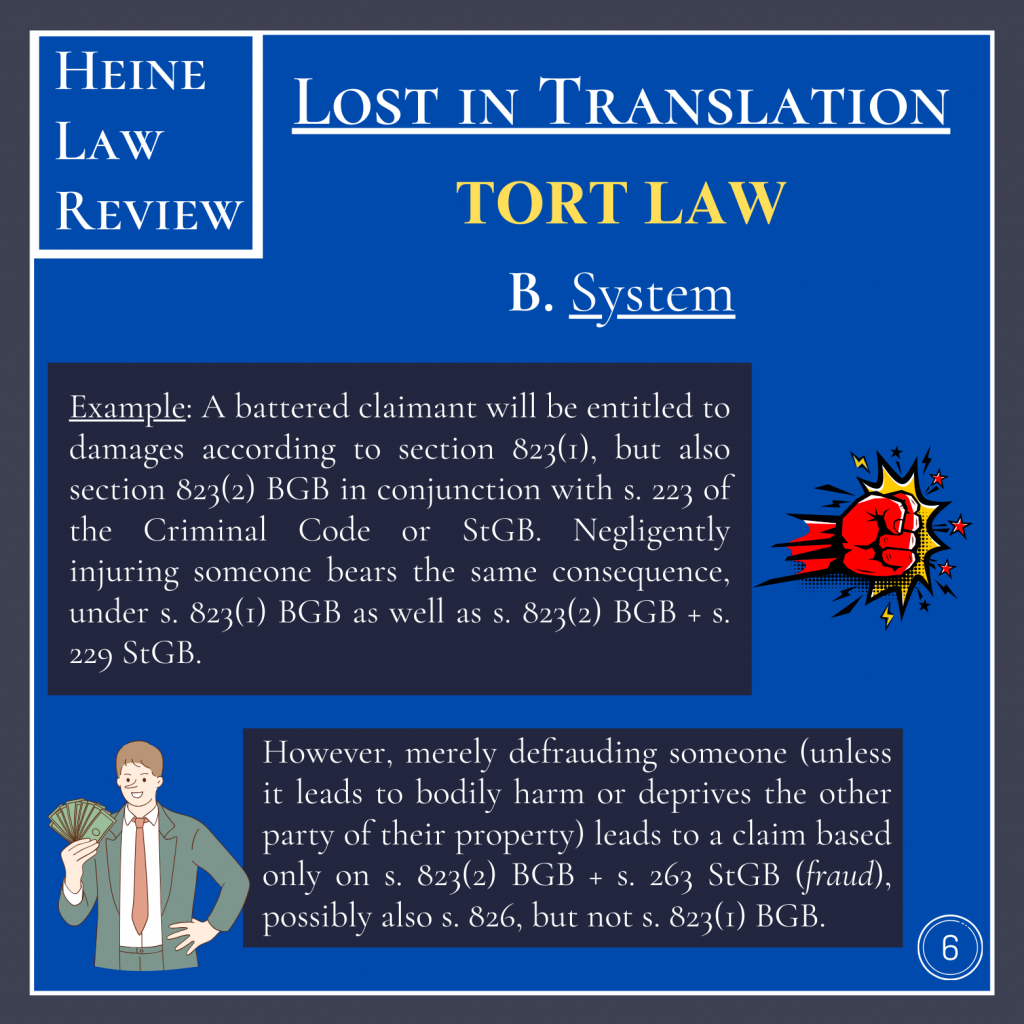
Example: A battered claimant will be entitled to damages according to section 823(1), but also section 823(2) BGB in conjunction with s. 223 of the Criminal Code or StGB. Negligently injuring someone bears the same consequence, under s. 823(1) BGB as well as s. 823(2) BGB + s. 229 StGB.
However, merely defrauding someone (unless it leads to bodily harm or deprives the other party of their property) leads to a claim based only on s. 823(2) BGB + s. 263 StGB (fraud), possibly also s. 826, but not s. 823(1) BGB.
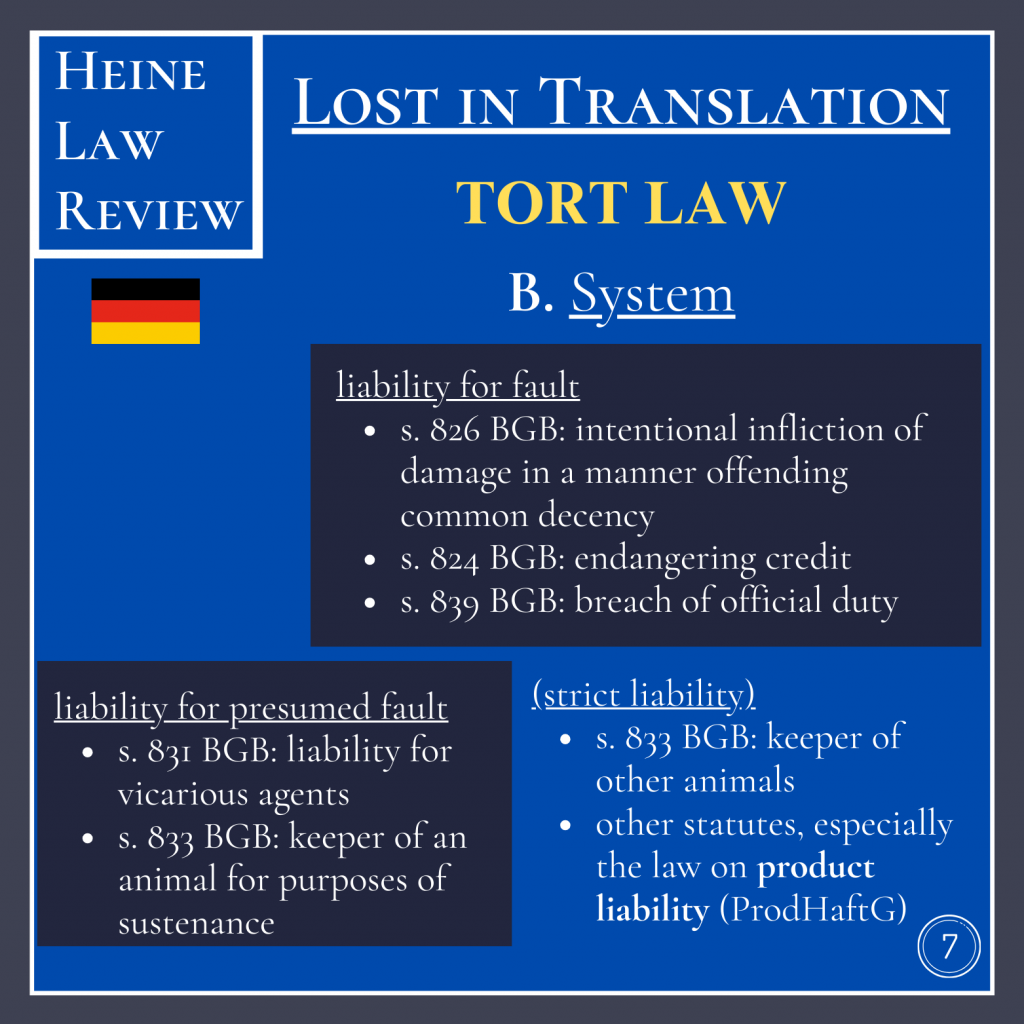
liability for fault
- s. 826 BGB: intentional infliction of damage in a manner offending common decency
- s. 824 BGB: endangering credit
- s. 839 BGB: breach of official duty
liability for presumed fault
- s. 831 BGB: liability for vicarious agents
- s. 833 BGB: keeper of an animal for purposes of sustenance
(strict liability)
- s. 833 BGB: keeper of other animals
- other statutes, especially the law on product liability (ProdHaftG)
C. Negligence
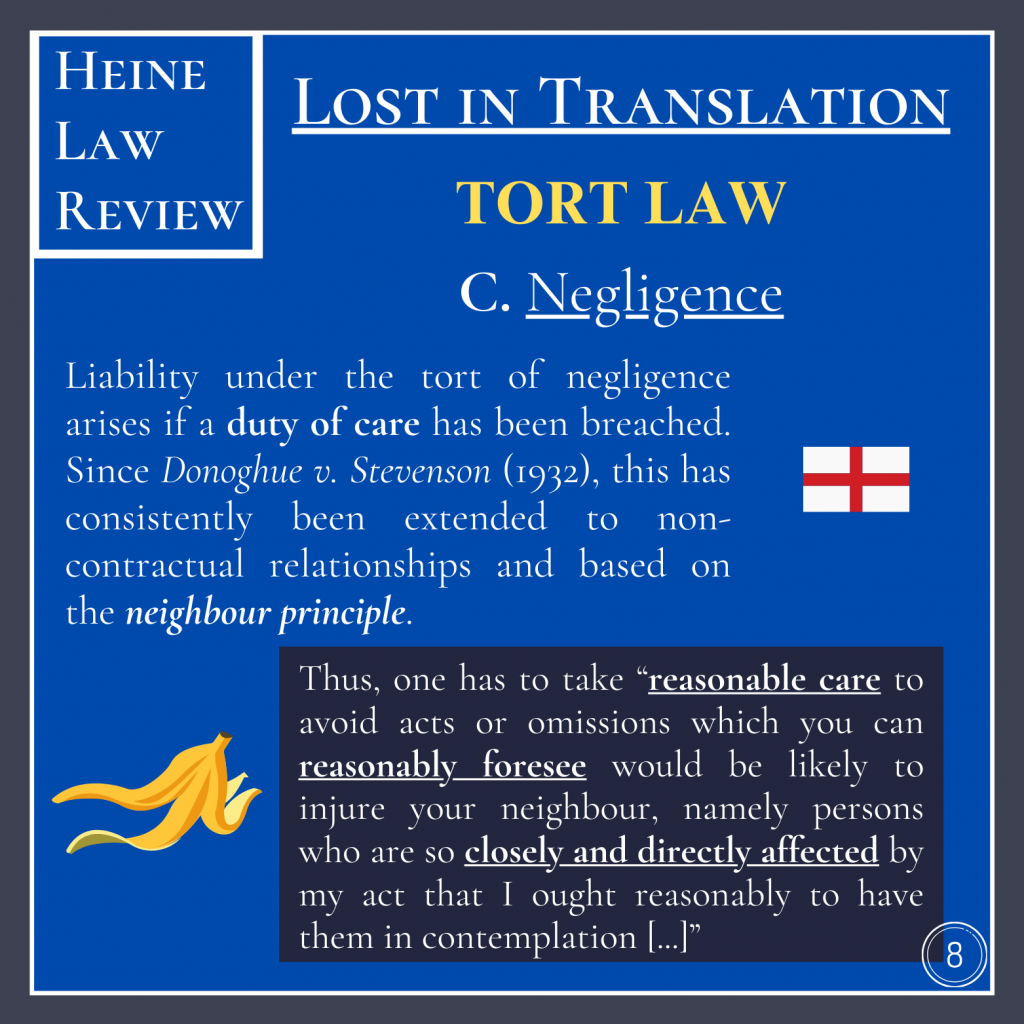
Liability under the tort of negligence arises if a duty of care has been breached. Since Donoghue v. Stevenson (1932), this has consistently been extended to non-contractual relationships and based on the neighbour principle.
Thus, one has to take “reasonable care to avoid acts or omissions which you can reasonably foresee would be likely to injure your neighbour, namely persons who are so closely and directly affected by my act that I ought reasonably to have them in contemplation […]”
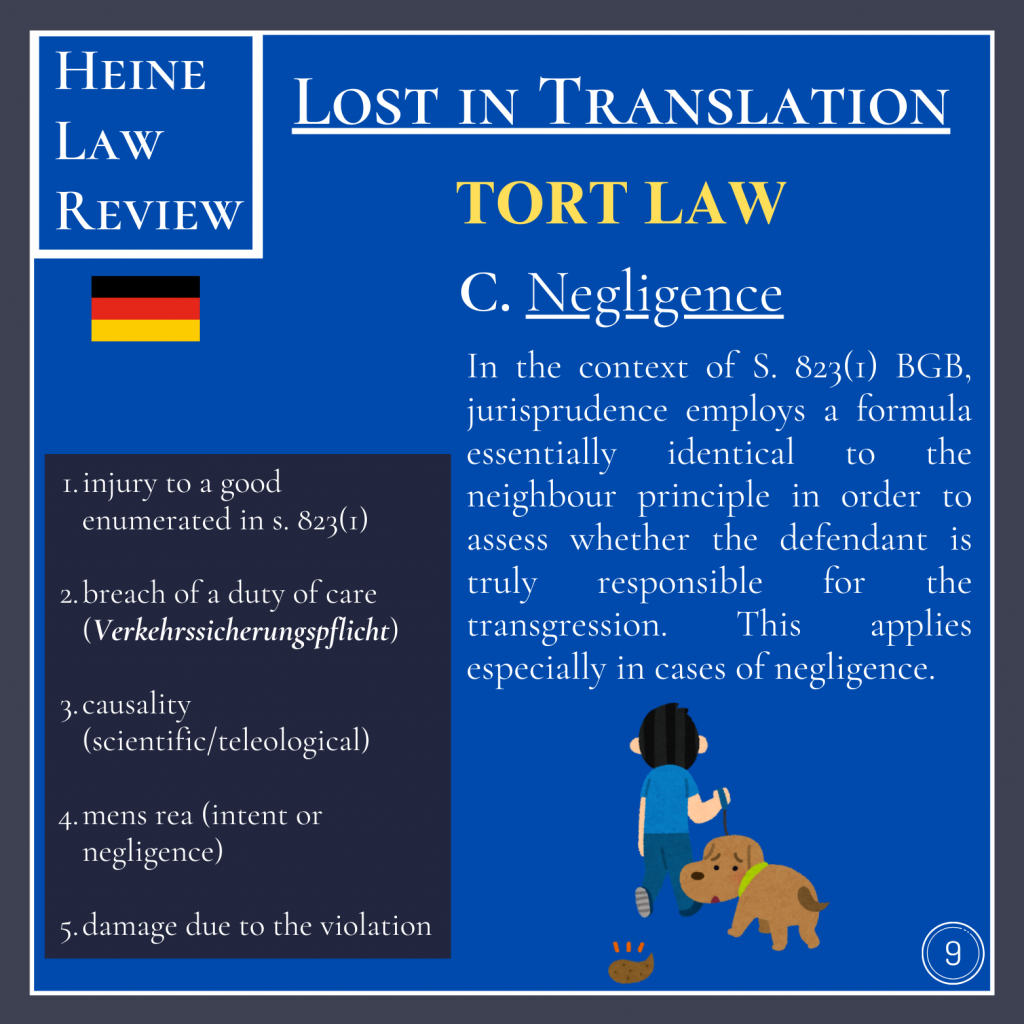
In the context of S. 823(1) BGB, jurisprudence employs a formula essentially identical to the neighbour principle in order to assess whether the defendant is truly responsible for the transgression. This applies especially in cases of negligence.
- injury to a good enumerated in s. 823(1)
- breach of a duty of care (Verkehrssicherungspflicht)
- causality (scientific/teleological)
- mens rea (intent or negligence)
- damage due to the violation.