Transcript:
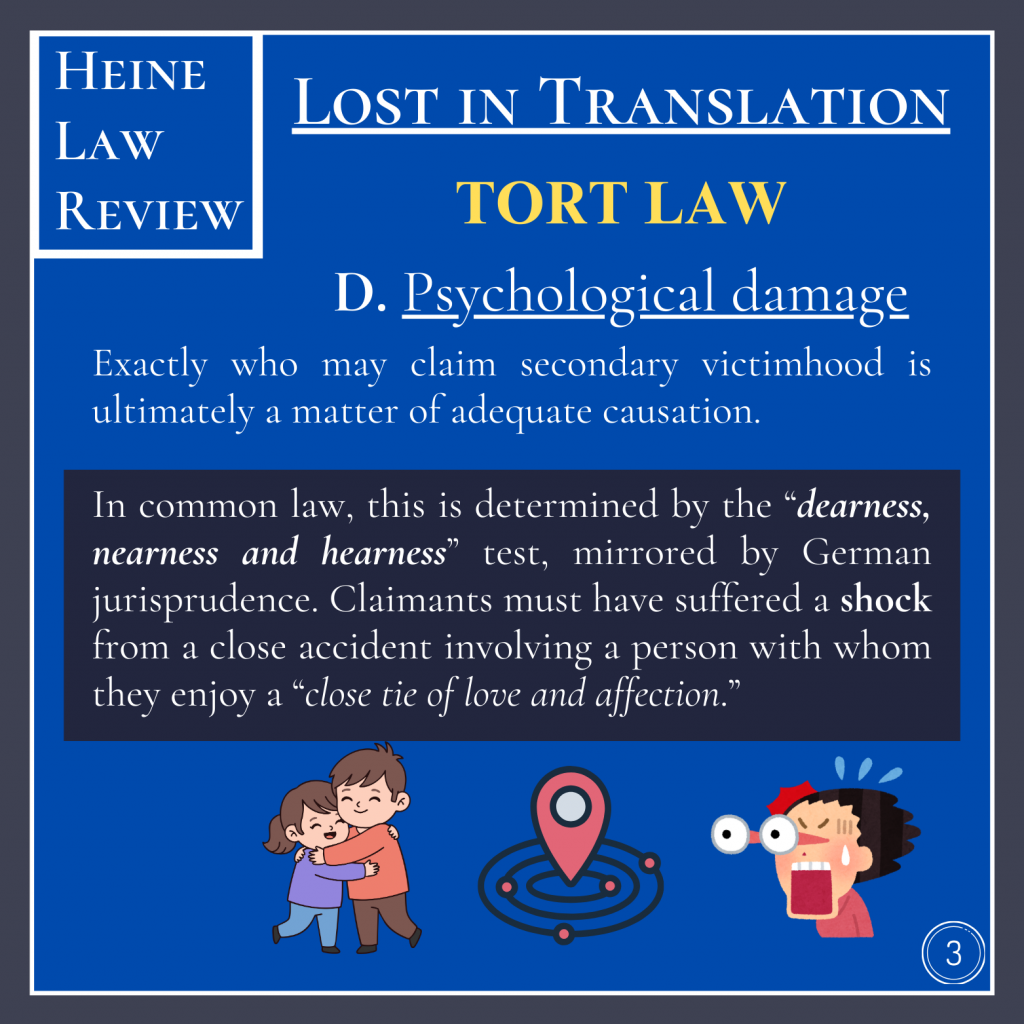
D. Psychological damage
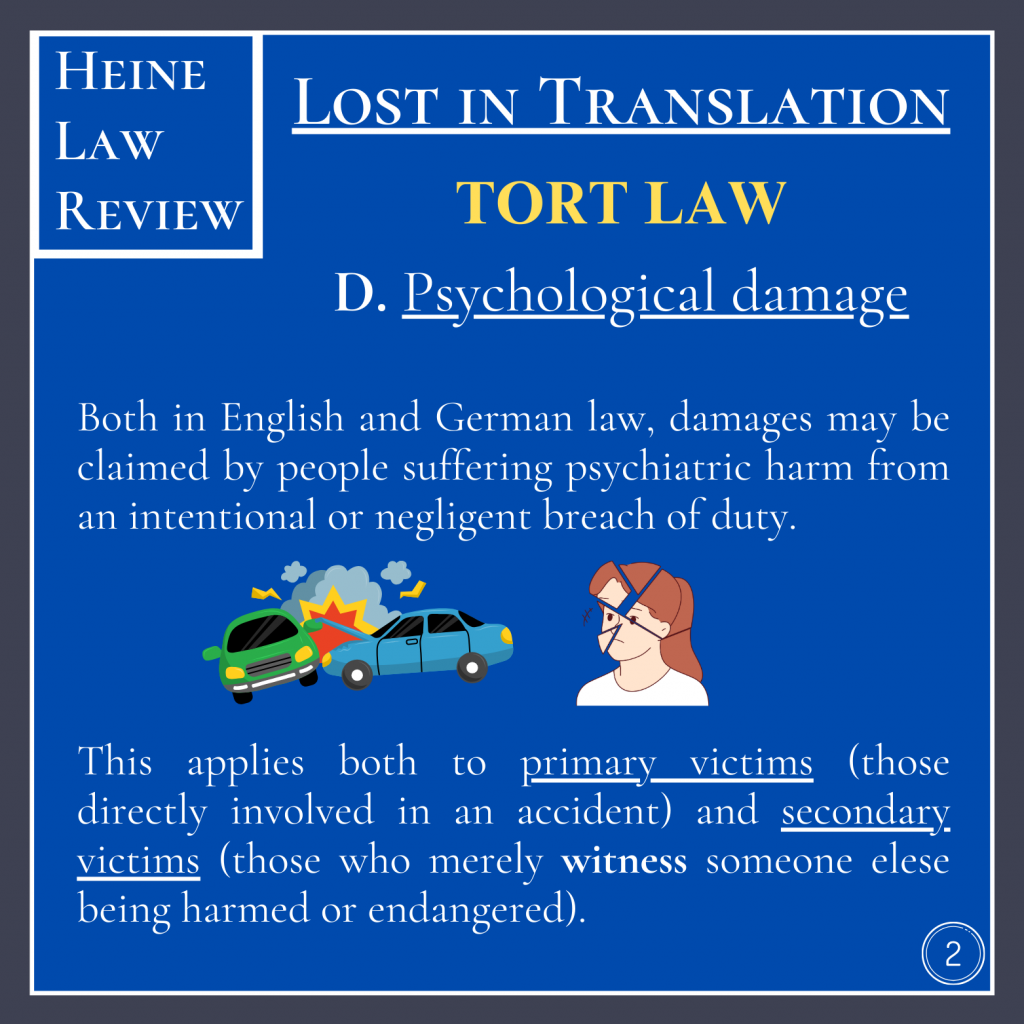
Both in English and German law, damages may be claimed by people suffering psychiatric harm from an intentional or negligent breach of duty. This applies both to primary victims (those directly involved in an accident) and secondary victims (those who merely witness someone else being harmed or endangered).
Exactly who may claim secondary victimhood is ultimately a matter of adequate causation. In common law, this is determined by the “dearness, nearness and hearness” test, mirrored by German jurisprudence. Claimants must have suffered a shock from a close accident involving a person with whom they enjoy a “close tie of love and affection.”
E. Vicarious Liability
S. 831 BGB provides for vicarious (additional, secondary) liability for deploying another person to perform a task. Like the common law doctrine of “respondeat superior“, s. 831 BGB applies to employees. However, it is also limited to such persons and allows the employer to exculpate himself if he proves not to have breached a duty of care.
F. Remedies
Ss. 842 and following of the BGB explicitly lay out remedies for killings or injuries. Among these are losses of income, funeral costs, and alimony.
Apart from that, remedies are regulated by ss. 249 and following. As in contract law, damages extend beyond mere monetary compensation, in the form of natural restitution (s. 249 BGB). If damages are awarded not in kind but in money, these are typically of a compensatory nature. Fundamentally, German law does not allow for punitive damages.
Damages may also include compensation for personal suffering, or immaterial damage. In principle, these are granted exclusively for violations of body, health, freedom or sexual self-determination (s. 253 BGB). Other cases require separate statutory ordinance.
Mandatory or prohibitory injunctions are awarded according to s. 1004 BGB if property is being infringed upon or is being threatened (Beseitigungs- oder Unterlassungsanspruch). The rule of s. 1004 has been extended analogously to other goods. Thus, an injunction may also be granted for health hazards or infringements on intellectual property.