

Transcript
D. Rights of equality
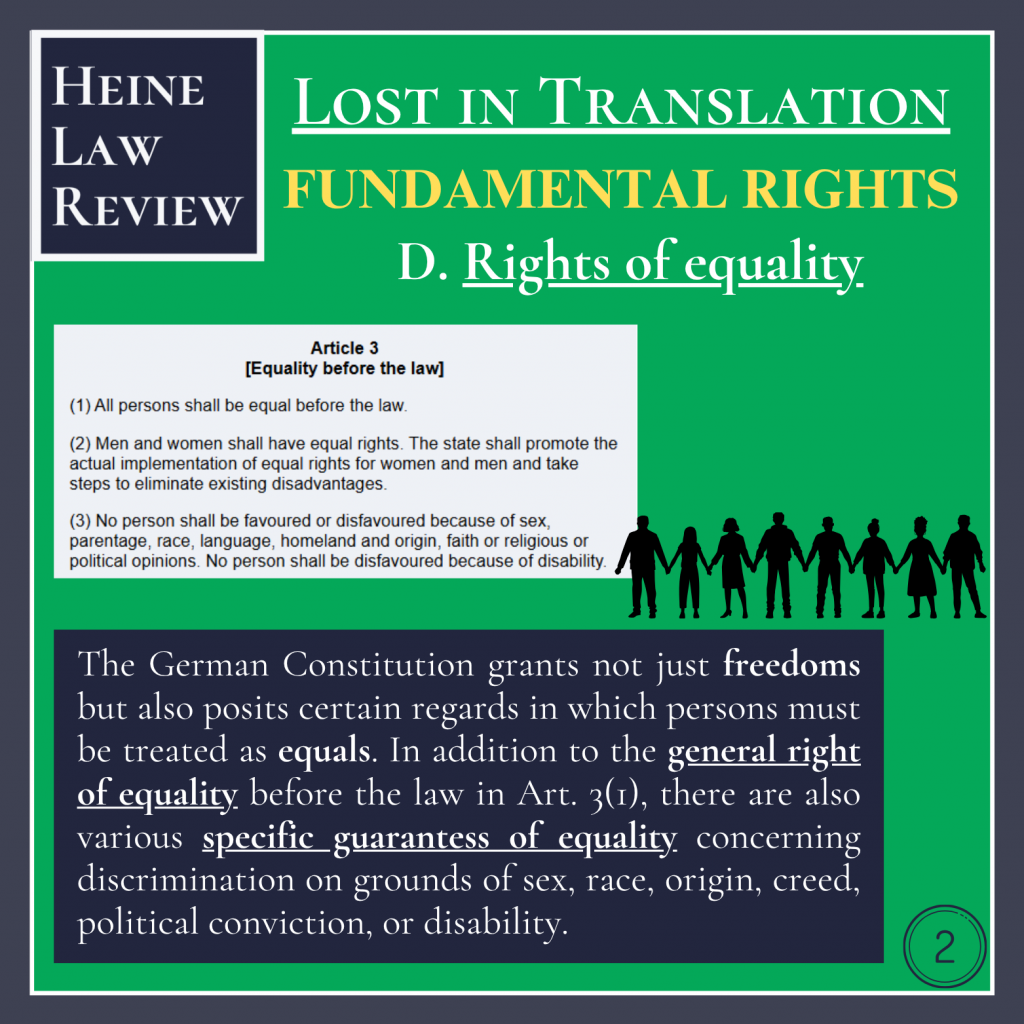
The German Constitution grants not just freedoms but also posits certain regards in which persons must be treated as equals. In addition to the general right of equality before the law in Art. 3(1), there are also various specific guarantees of equality concerning discrimination on grounds of sex, race, origin, creed, political conviction, or disability. Several other guarantees are sprinkled throughout, e.g. as regards illegitimate children in Art. 6(5), equal access to public office in Art. 33, or equal voting rights in Art. 38(1). Art. 21(1) serves the same function for political parties as Art. 38(1) s. 1 does for their voters.
As it was with liberties, all rights of equality mostly function according to the same overall scheme. One difference is that Art. 3(1), as a catch-all provision, offers a lower standard of protection compared to prohibitions of discrimination on specific grounds. The latter also include indirect or hidden discriminations.
Since Art. 1(3) clarifies that all public authority is bound by “the following basic rights“, the Weimar-era dispute as to what “equality before the law” entails has ultimately been resolved. Equality before the law denotes both equal application of the law and equal legislation. Therefore, the precept of Art. 3(1) may be summarised thusly: Public authority must treat essentially equal situations equally but also, conversely, essentially unequal situations inequally. More specifically, the same autonomous body (the federation, the states, the municipalities etc.) must grant the same legally licit treatment in every comparable case, or else justify the unequal conduct unless it is inherent in the constitution itself (such as the draft applying only to men).
Justification requires, in principle, merely a factual reason. However, if the unequal treatment is related to personal attributes or the exercise of constitutional liberties, the threshold shifts closer and closer to one of strict proportionality.
In practice, Art. 3(1) serves as the basis for derivative participatory rights in conjunction with freedom rights or administrative conduct in fundamentally equal cases (see last week’s instalment). Moreover, Art. 3(1) as applied to the legislature is also said to function as the magna carta of German tax law, ensuring taxation is equitably tied to performance.
E. Private parties
Due to their enjoyment of civil and economic liberties, private parties are generally not bound to respect fellow persons’ freedoms or claims to equal treatment as the state is. Where necessary and proper, the legislature passes laws in observance of their protective duties, but these also have to respect the rights of third parties. The only written exception to this principle: Art. 9(2) s. 2 renders void any agreement seeking to impair the right to form unions, including private ones.
However, even in civil trials, a judicial decision that does not take into due consideration the claimant’s or defendant’s basic rights may constitute an infringement. The basic rights enumerated in the Grundgesetz represent an order of objective values. By way of these protective duties, jurisprudence thus constructs indirect third-party effects of fundamental rights. These come in handy whenever one has to discern e.g. if a contract clause is immoral or in breach of trust.