

Transcript
A. Introduction
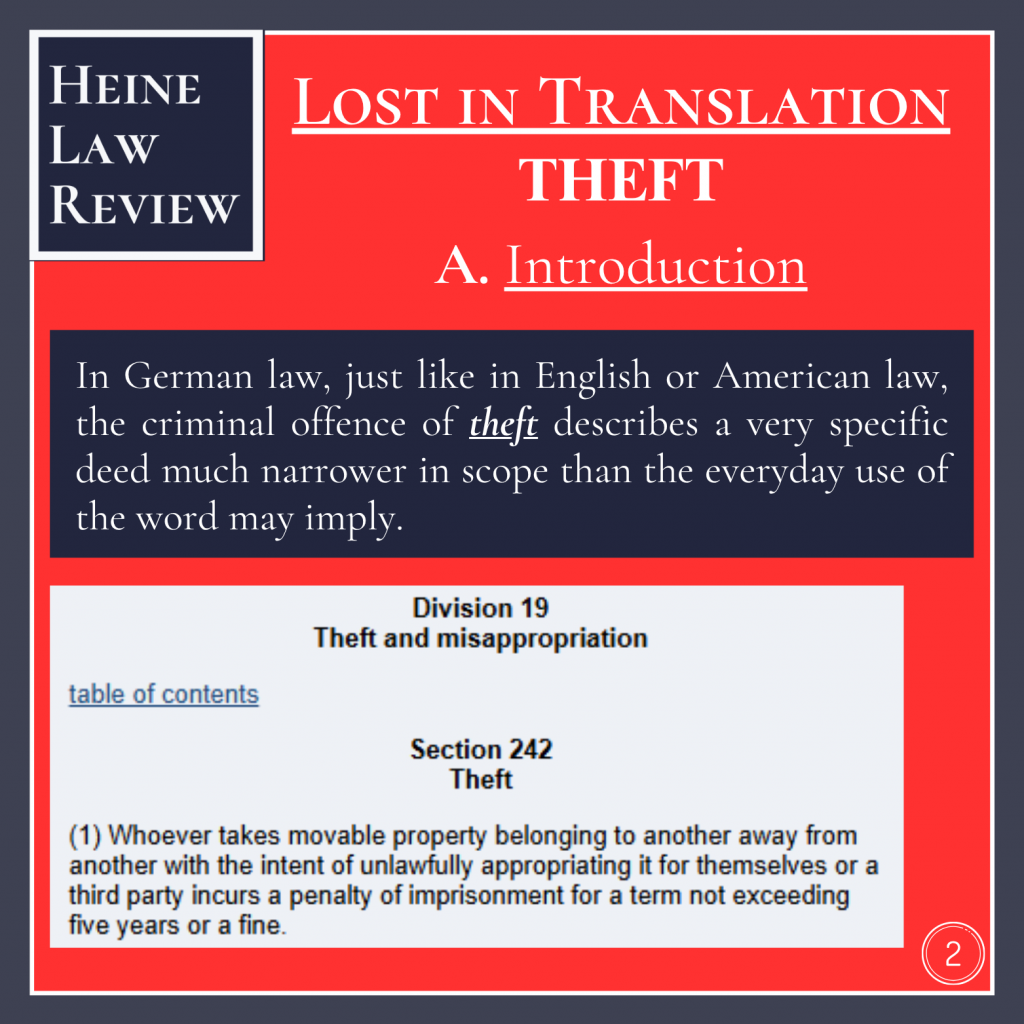
In German law, just like in English or American law, the criminal offence of theft describes a very specific deed much narrower in scope than the everyday use of the word may imply.
Section 242: Theft
(1) Whoever takes movable property belonging to another away from another with the intent of unlawfully appropriating it for themselves or a third party incurs a penalty of imprisonment for a term not exceeding five years or a fine.
Theft must therefore be distinguished from other crimes against another person’s property or wealth, such as property damage (s. 303), but especially mere misappropriation (s. 246), joyrides (s. 248b), or fraud (s. 263). We will do so in analysing the various elements of s. 242 StGB.
Additional issues arise whenever force or threats are employed, so that the theft may qualify as a robbery acc. to s. 249.
B. Actus reus
The offender must have taken away moveable property belonging to another. This includes any “thing”, as defined by civil law, excluding incorporeal objects (cf. s. 90 BGB) but including animals (cf. s. 90a BGB). For electricity, there is the separate offence of s. 248c StGB.
S. 242 serves to protect not just the right or title to property, but also the mere possession of or custody over it. Thus, although the object must be legally owned by at least one other person, it does not have to be in the possession of its legal owner at the time of the offence.
The concept of custody over the property is central to what constitutes it being taken away. At the time the offence is committed, someone other than the offender must had factual control over the object, according to accepted standards.
The “thief” must not have had sole or overriding custody. For example, the owner of a shop cannot steal inventory from his own employees, whereas a cashier may exert custody even against their immediate superiors if they are transferred exclusive responsibility for their cash register.
The thief must have broken another’s custody and established it anew. Furthermore, this must have taken place without or against the will of the victim. Consent functions not as a defence but as an integral (negative) element of the offence. It is on this level that theft and robbery on one hand are distinguished from fraud and extortion on the other.
It is immaterial whether consent to the surrender has been achieved using fraudulent methods. What is decisive is whether consent given by a third party can be attributed to the custodian because they are in fact much closer to the property than a random stranger would (being “in the camp“ of the custodian.)
C. Mens rea
In addition to acting intentionally more generally (s. 15), the thief must also have acted “with the intent of unlawfully appropriating it for themselves or a third party”. Even though appropriation is not an objective element of s. 242 (unlike s. 246), it nevertheless forms a special component of the mens rea.
The thief must act in order to wilfully acquire the property for themselves while at least being in consideration of the fact that they thereby disappropriate the previous owner. The less strict requirements for the latter part reflect that thieves mostly act egotistically but with the primary intent to enrich themselves, not damage others.
The process of appropriation is a factual, not a legal one. Not possessing good faith, the thief may not legally acquire a property title by way of usucaption (s. 937 BGB). The thief instead appropriates the thing by acting like its owner, in place of the real one.
Acquisition and disappropriation may relate either to the thing itself in its substance or to its intrinsic value. Thus, the thief may appropriate the value of a savings book by drawing money from it. The thief may also appropriate an object itself by reselling it, even to its original owner as long as this fact is not disclosed.
On the other hand, merely damaging or destroying something does not qualify as an appropriation. An exception applies if the object is used or used up as intended, especially if food or drink is consumed. Immediately disposing of something after having taken it away does not qualify either.
Lastly, something is not being stolen if – from the very beginning – the offender intended to return it shortly without any meaningful changes in value, or let the previous owner themselves repossess it without substantial effort.