Transcription
C. Apparent authority
As aforementioned, the power of the agent to represent the principal may derive from statute, from the status of an organ, or from a declaration of authorisation by the principal. In addition, it is sometimes sufficient if the third party merely assumed that the agent had been authorised. Common to all the different forms of apparent authority is that the third party must have positively believed in the agent’s authority, with sufficient cause to assume it in good faith, with regard for general custom.
For one, authority is apparent if the principal is cognisant of the principal’s conduct and nevertheless does not prevent them from acting in their name. This authority by acquiescence does not require multiple occurences of such behaviour.
Apparent authority by way of mere appearance is granted without the principal’s knowledge if they could have prevented the agent from acting for them for some time or with a certain regularity. The question what exactly suffices to constitute authority by appearance can be quite difficult to answer. Evidently, someone who seems to be charged with a certain task can be assumed to carry the necessary authority as far as legal transactions are concerned. This principle is indicated in s. 56 of the Commercial Code (HGB) for shop employees. Among other things, the German Federal Court (BGH) has also affirmed such prima facie liability for the negligent surrender of an eBay-account.
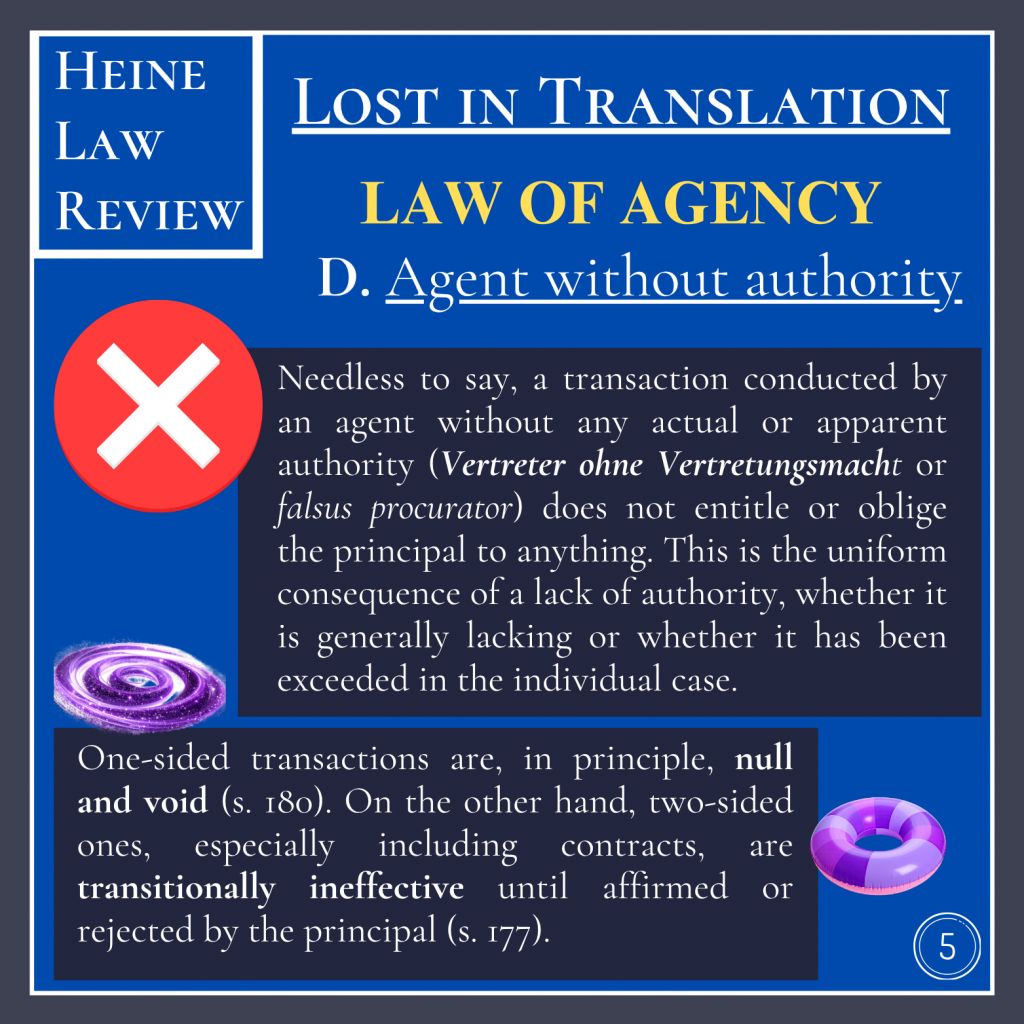
D. Agent without authority
Needless to say, a transaction conducted by an agent without any actual or apparent authority (Vertreter ohne Vertretungsmacht or falsus procurator) does not entitle or oblige the principal to anything. This is the uniform consequence of a lack of authority, whether it is generally lacking or whether it has been exceeded in the individual case.
One-sided transactions are, in principle, null and void (s. 180). On the other hand, two-sided ones, especially including contracts, are transitionally ineffective until affirmed or rejected by the principal (s. 177).
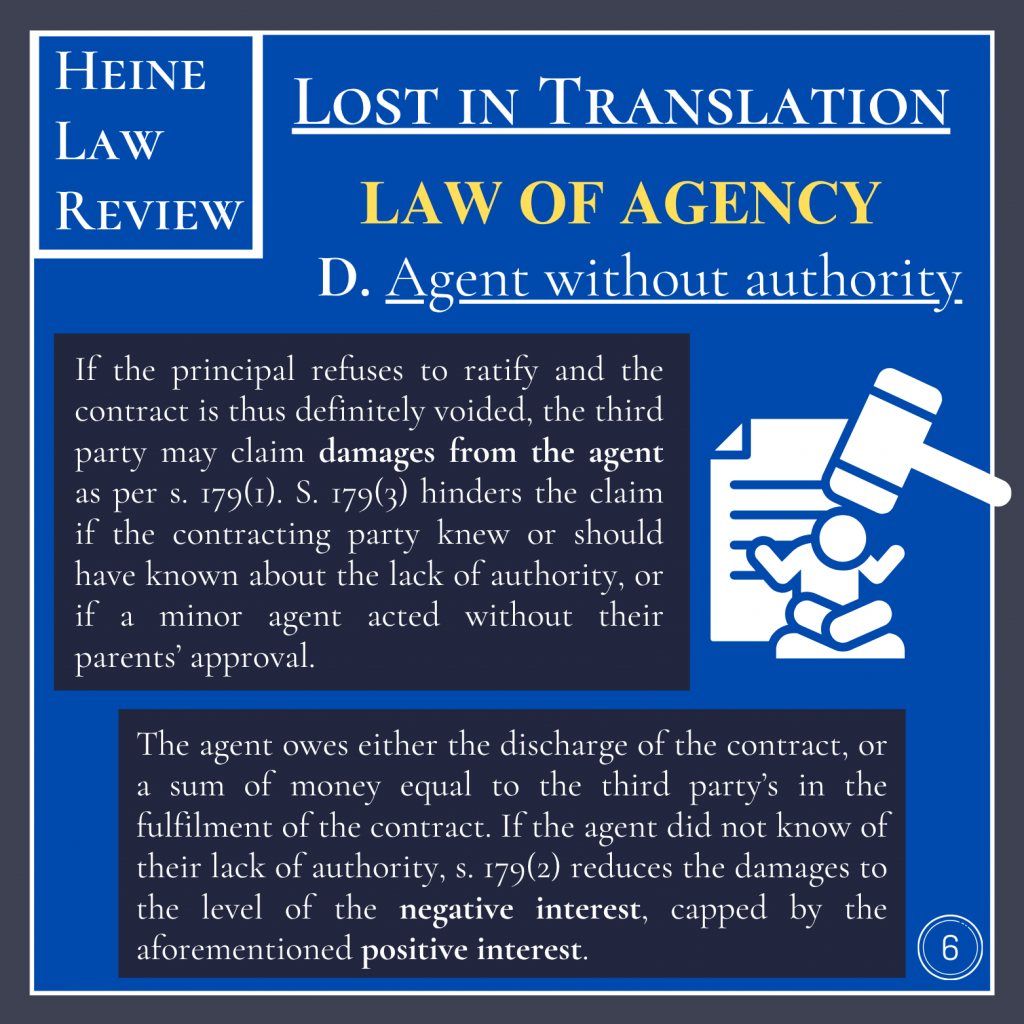
If the principal refuses to ratify and the contract is thus definitely voided, the third party may claim damages from the agent as per s. 179(1). S. 179(3) hinders the claim if the contracting party knew or should have known about the lack of authority, or if a minor agent acted without their parents’ approval. The agent owes either the discharge of the contract, or a sum of money equal to the third party’s in the fulfilment of the contract. If the agent did not know of their lack of authority, s. 179(2) reduces the damages to the level of the negative interest, capped by the aforementioned positive interest.
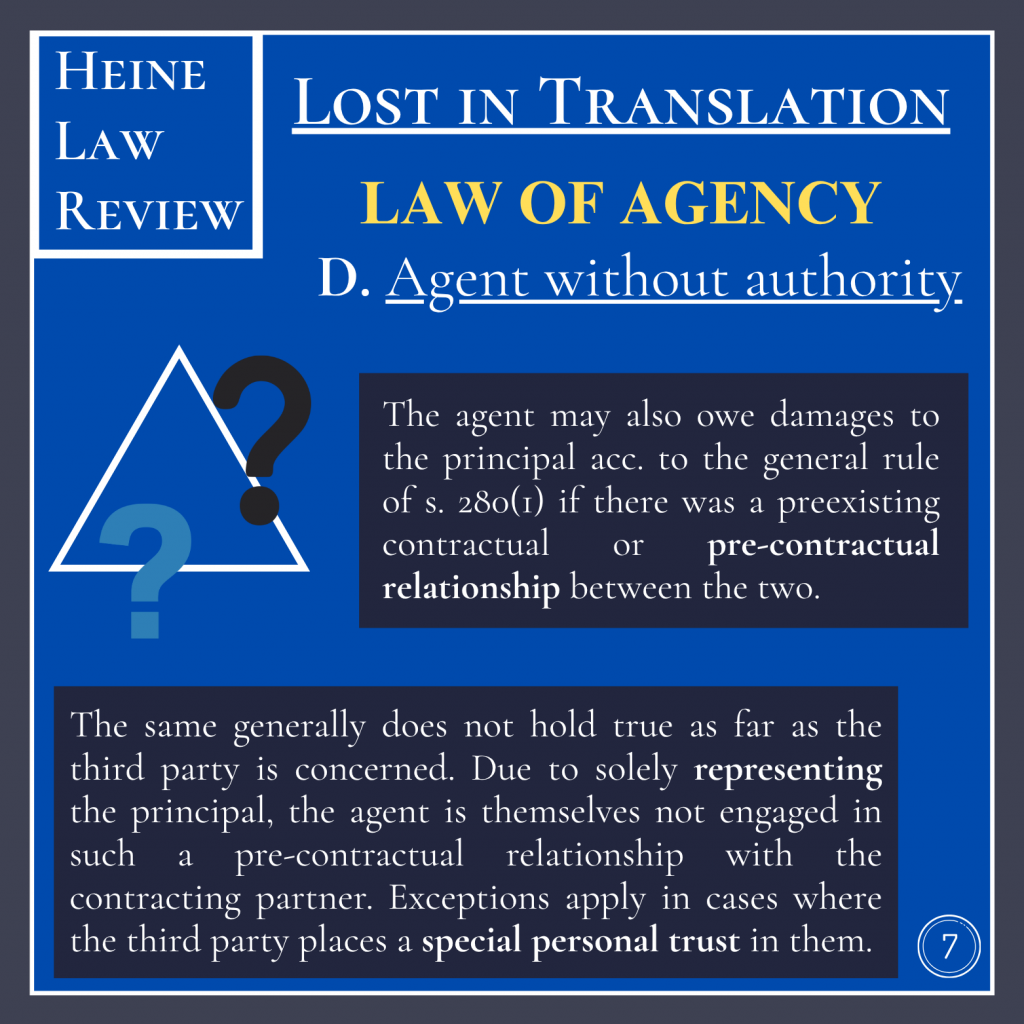
The agent may also owe damages to the principal acc. to the general rule of s. 280(1) if there was a preexisting contractual or pre-contractual relationship between the two.
The same generally does not hold true as far as the third party is concerned. Due to solely representing the principal, the agent is themselves not engaged in such a pre-contractual relationship with the contracting partner. Exceptions apply in cases where the third party places a special personal trust in them.
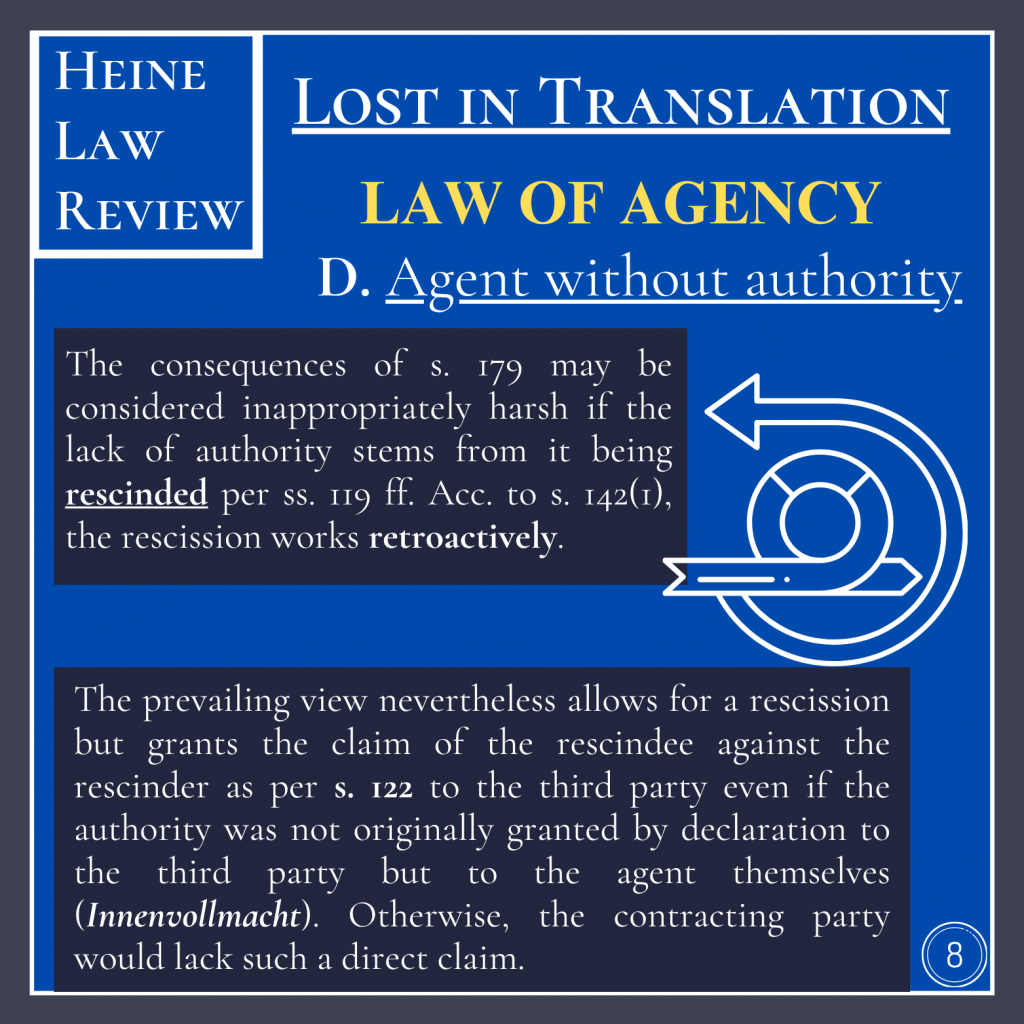
The consequences of s. 179 may be considered inappropriately harsh if the lack of authority stems from it being rescinded per ss. 119 ff. Acc. to s. 142(1), the rescission works retroactively. The prevailing view nevertheless allows for a rescission but grants the claim of the rescindee against the rescinder as per s. 122 to the third party even if the authority was not originally granted by declaration to the third party but to the agent themselves (Innenvollmacht). Otherwise, the contracting party would lack such a direct claim.