

Transcript
D. Aggravated theft
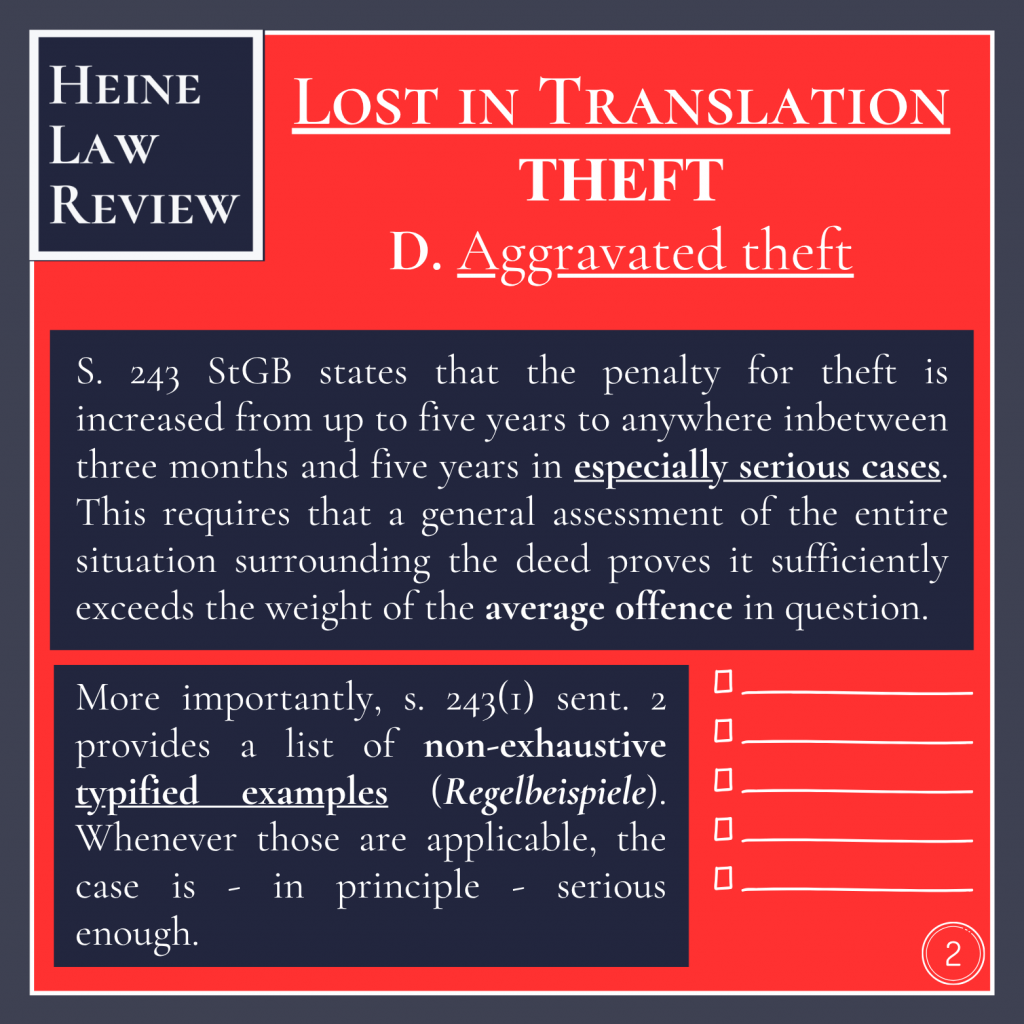
S. 243 StGB states that the penalty for theft is increased from up to five years to anywhere inbetween three months and five years in especially serious cases. This requires that a general assessment of the entire situation surrounding the deed proves it sufficiently exceeds the weight of the average offence in question.
More importantly, s. 243(1) sent. 2 provides a list of non-exhaustive typified examples (Regelbeispiele). Whenever those are applicable, the case is – in principle – serious enough. The examples mentioned are:
- burglaries, i.e. breaking into premises or employing ways or tools not typically used to gain access, or false keys (no. 1)
- stealing items specially protected against theft through a sealed container or other protective device (no. 2)
- stealing on a commercial basis (no. 3)
- stealing items used for worship (no. 4)
- stealing relavant items that are generally accessible or publicly exhibited (no. 5)
- exploiting a state of helplessness or similar (no. 6)
- stealing certain weapons (no. 7).
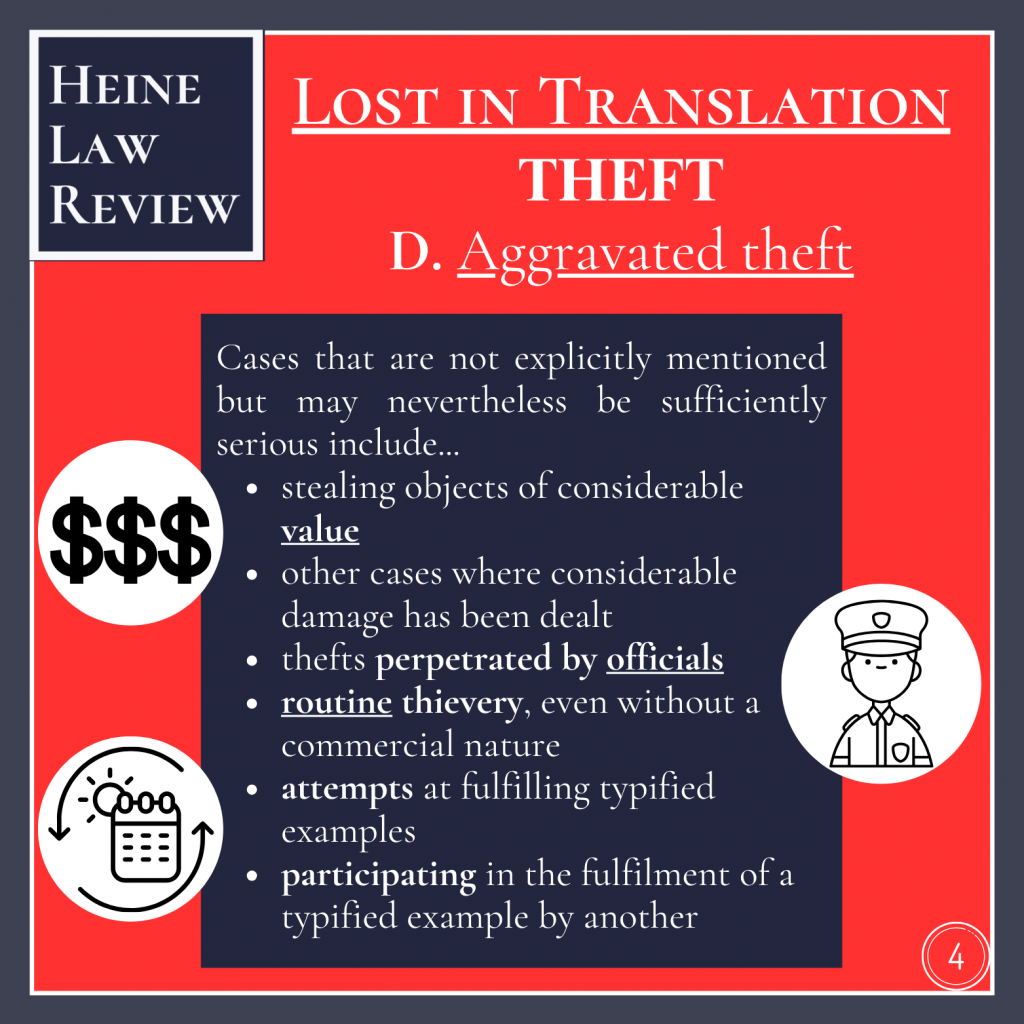
Cases that are not explicitly mentioned but may nevertheless be sufficiently serious include…
- stealing objects of considerable value
- other cases where considerable damage has been dealt
- thefts perpetrated by officials
- routine thievery, even without a commercial nature
- attempts at fulfilling typified examples
- participating in the fulfilment of a typified example by another.
E. Qualified theft
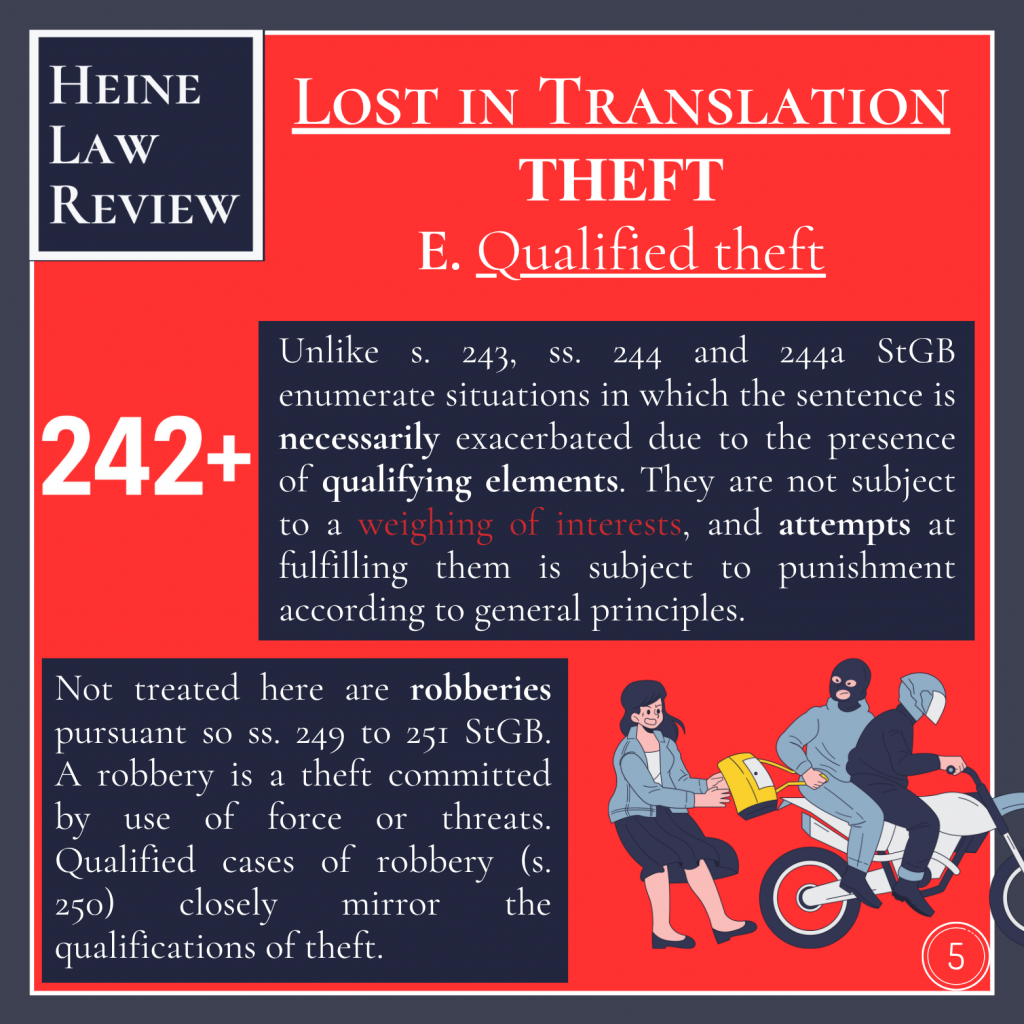
Unlike s. 243, ss. 244 and 244a StGB enumerate situations in which the sentence is necessarily exacerbated due to the presence of qualifying elements. They are not subject to a weighing of interests, and attempts at fulfilling them is subject to punishment according to general principles.
Not treated here are robberies pursuant so ss. 249 to 251 StGB. A robbery is a theft committed by use of force or threats. Qualified cases of robbery (s. 250) closely mirror the qualifications of theft.
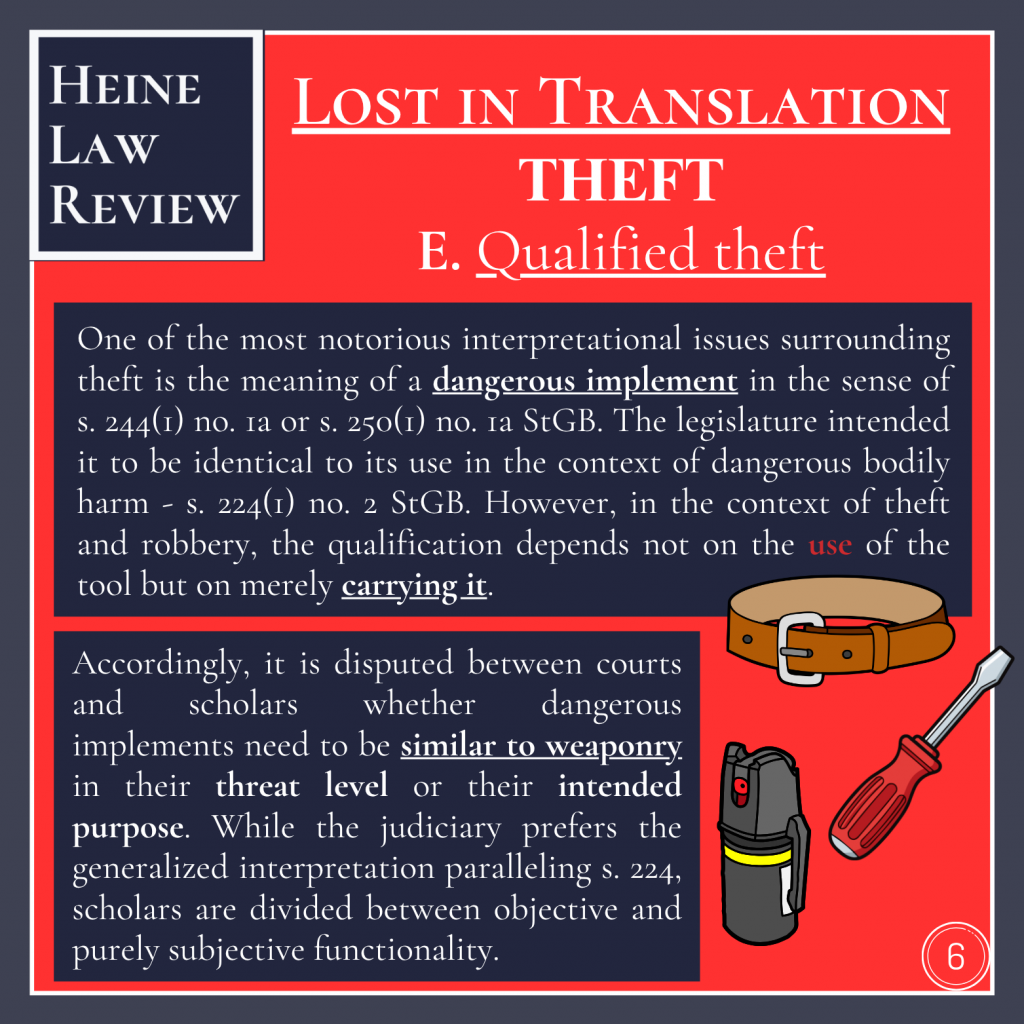
One of the most notorious interpretational issues surrounding theft is the meaning of a dangerous implement in the sense of s. 244(1) no. 1a or s. 250(1) no. 1a StGB. The legislature intended it to be identical to its use in the context of dangerous bodily harm – s. 224(1) no. 2 StGB. However, in the context of theft and robbery, the qualification depends not on the use of the tool but on merely carrying it. Accordingly, it is disputed between courts and scholars whether dangerous implements need to be similar to weaponry in their threat level or their intended purpose. While the judiciary prefers the generalized interpretation paralleling s. 224, scholars are divided between objective and purely subjective functionality.
S. 244(1) no. 2 and s. 244a concern stealing as part of a gang (Bande). A gang is any coalition of at least 3 persons for the wilful purpose of committing a multitude of as of yet unspecified thefts or robberies over a certain time period. The qualified theft must be committed as part of a gang and with participation (of any nature) by at least one other member. Under these conditions, the penalty increases to 6 months to 10 years. A burglary or armed theft committed as part of a gang even carries a sentence of 1-10 years (s. 244a).
F. Misappropriation
As covered in Part I, “theft” by definition requires the tranfer of custody without the previous custodian’s consent, but with the intent to appropriate the object. S. 246 StGB serves as a – somewhat complicated – alternative, which demands neither a break in custody nor the direct intent. Rather, the appropriation of another’s moveable property forms part of the actus reus, i.e. it constitutes an objective element.
It is disputed between judges and scholars whether appropriation should be taken as a purely objective process, or as the manifestation of the intent in the sense of ss. 242 ff. Prevailing opinion prefers a narrow interpretation, demanding an unequivocal demonstration of said intent. Recently, the Federal Court of Justice (BFH) has departed from this view, citing the phrasing of s. 246 and the autonomy of criminal law terminology. In their opinion, s. 246 requires no more than relieving someone of their property and acquiring it themselves, in fact.
It is also controversial whether appropriation can be repeated by the same offender without having lost custody. The judiciary denies that the elements of s. 246(1) are satisfied in this case, while scholars prefer that the offender be punished only for the first of these competing misappropriations.